
Duplex steels S31803 & S32205 forged fittings are widely used austenitic – ferritic duplex stainless steel grades, combining the corrosion resistance of austenitic stainless steels with the high strength of ferritic stainless steels. In the field of forged pipe fittings, they are used for the manufacture of piping fittings that are resistant to high pressures, temperatures and corrosive environments, such as elbows, tees, socket weld fittings, threaded pipe caps, etc.
Duplex stainless steels S31803 and S32205 are duplex stainless steels of type 2205 (UNS No. S31803 and S32205, respectively), and their wrought fittings are widely used in piping systems under harsh working conditions due to the dual characteristics of austenite and ferritic.
S31803 & S32205 Overview
Duplex stainless steels are called “duplex” because their microstructure consists of approximately equal amounts of austenite (FCC) and ferrite (BCC). This unique two-phase structure gives them properties that are superior to single austenitic or ferritic stainless steels:
High Strength: Yield strength is typically twice that of austenitic stainless steels (e.g., 304L, 316L), which allows thinner wall thicknesses in design and fabrication, resulting in weight and cost reductions.
Excellent corrosion resistance: Excellent resistance to pitting, crevice corrosion, intergranular corrosion and stress corrosion cracking (SCC), especially in chloride-containing environments. This is primarily due to its high chromium (Cr), molybdenum (Mo) and nitrogen (N) content.
Good weldability: Duplex steels S31803 & S32205 forged fittings have better weldability than some other high-alloyed steels.
Low Coefficient of Thermal Expansion and High Thermal Conductivity: Compared to austenitic stainless steels, duplex stainless steels have a lower coefficient of thermal expansion and better thermal conductivity.
S31803 is the original 2205 duplex stainless steel grade. Subsequently, in order to obtain superior corrosion resistance and avoid the formation of intermetallic phases, by more strictly controlling the content range of chromium, molybdenum and nitrogen, S32205 grade was developed.S32205 is an optimized version of S31803, which is usually superior in performance, so in many cases 2205 duplex stainless steels are referred to as S32205.
Specifications of Duplex Steel Forged Fittings:
| Size | 1/2″NB TO 4″NB IN |
| Standard | ASTM A182 / ASME SA182 |
| Dimensions | ANSI/ASME B16.11 & BS3799, etc. |
| Grade | UNS S31803, S32205, S2205, S32550, S32750, S32760. |
| Class | 2000LBS, 3000LBS, 6000LBS, 9000LBS, etc. |
| Type | Socketweld Fittings, Screwed-Threaded Fittings |
Duplex Steel S31803 & S32205 Forged Fittings Manufacturing Standards :
ASTM A182 – ASME SA182 Standard: Specification for Wrought Austenitic Duplex Steel Piping Fittings
ASME B16.11: Socket Welding and Threaded Forged Fittings
MSS SP-43: Wrought and Fabricated Butt-Welding Fittings for Low Pressure, Corrosion Resistant Applications
MSS SP-95: Swage(d) Nipples and Bull Plugs
BS3799: Specification for Steel pipe fittings, screwed and Socket-welding for the petroleum industry
Chemical Composition of Duplex Steel S31803 & S2205 Forged Fitting:
| CHEMICAL | LIMITS | C | Mn | P | S | Si | Ni | Cr | Mo | N |
| ASTM A182 F51 | MIN | 4.50 | 21.00 | 2.50 | 0.08 | |||||
| MAX | 0.03 | 2.00 | 0.030 | 0.020 | 1.00 | 6.50 | 23.00 | 3.50 | 0.20 | |
| ASTM F60 | MIN | 4.50 | 22.00 | 3.00 | 0.14 | |||||
| MAX | 0.03 | 2.00 | 0.030 | 0.020 | 1.00 | 6.50 | 23.00 | 3.50 | 0.20 |
UNS S31803 & S32205 Duplex Steel Forged Fitting Mechanical properties
| MATERIAL | ASTM A182 F51 | ASTM A182 F60 |
| T.S (MPA) | 620 min | 655min |
| Y.S (MPA) | 450 min | 450min |
| EL % | 25 min | 25min |
| R/A % | 45 min | 45min |
Advantages of Forged Fittings
Optimized grain structure: The forging process refines the grains and eliminates internal defects by applying pressure to the metal and causing it to plastically deform at high temperatures, so that the metal grains are aligned along the direction of the stress to form a denser, more uniform fibrous tissue.
Higher strength and toughness: Duplex steels S31803 & S32205 forged fittings have more excellent mechanical properties, including higher yield strength, tensile strength and impact toughness, as well as better fatigue resistance.
Better corrosion resistance: uniform and dense grain structure and the elimination of internal defects to help improve the overall corrosion resistance of the pipe fittings, reducing corrosion-sensitive areas.
Longer service life: Combined, Duplex stainless steels S31803 & S32205 forged fittings provide more stable performance and longer service life under severe service conditions.
Dimensional accuracy and surface quality: Precision forging provides better dimensional accuracy and surface quality, reducing the need for subsequent machining.
Manufacturing Process of Forged Fittings
Forging: Plastic deformation of heated raw material on forging equipment to form the preliminary shape of pipe fittings such as elbows, tees, flanges, etc. Forging can be free forging or die forging.
Heat Treatment: Solution treatment is required after forging. This usually involves solution annealing at elevated temperatures (e.g. 1020-1100 °C) followed by rapid cooling (e.g. water quenching) to ensure that the austenite and ferrite phases are in balance and that no harmful intermetallic phases precipitate, thus restoring and optimizing the material’s organization and properties.
Machining and Finishing: Machining, chamfering, polishing, etc. of the forged and heat-treated fittings to achieve final dimensional accuracy and surface finish.
Inspection: Rigorous quality inspection, including chemical composition analysis, mechanical property testing (tensile, impact, hardness), metallographic examination, non-destructive testing (e.g. ultrasonic, ray detection) and dimensional inspection.
Types of Duplex Steel Forged Fittings
Duplex steels S31803 & S32205 forged fittings are primarily categorized by their connection method into two main types: Threaded Fittings and Socket Weld Fittings.
These two connection methods determine how the fittings are installed and connected within a piping system, which in turn dictates their respective application scenarios, pressure ratings, and specific advantages and disadvantages.
Threaded (THD / Screwed) Fittings:
Characteristics: The fitting has internal or external threads (usually NPT or BSPT standards) that connect to the pipe via a threaded connection.
Applications: Suitable for small-bore, medium-to-low pressure, non-critical piping systems. They are easy to install and disassemble, requiring no welding. Commonly used in instrumentation lines, hydraulic systems, and pneumatic systems.
Pressure Ratings: Typically available in Class 2000 LBS, 3000 LBS, 6000 LBS, etc.
Characteristics: The fitting has an internal bore (socket) into which the pipe is inserted. The connection is then made by a fillet weld on the exterior of the fitting. This means the weld is outside the pipe, preventing it from affecting the pipe’s inner diameter.
Applications: Suitable for small-bore, high-pressure, high-temperature piping systems, especially those where a smooth internal wall is not strictly required, or where internal corrosion or scaling needs to be prevented (since the weld is external). Commonly used in the chemical, petroleum, and power industries.
Pressure Ratings: Typically available in Class 3000 LBS, 6000 LBS, 9000 LBS, etc.
Duplex Steel Threaded Fittings Dimensions
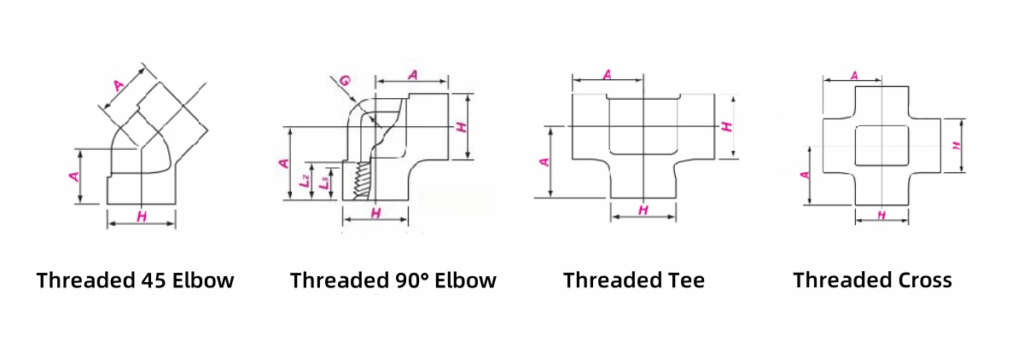
| Nominal Size | Center-to-End | Outside Diameter of Band | Wall Thickness | Length of Thread | |||||||||||
| DN | NPS | A | H | G min | L5 min | L2 min | |||||||||
| 90° Elbows, Tees, Crosses | 45 ° Elbows | ||||||||||||||
| 2000 | 3000 | 6000 | 2000 | 3000 | 6000 | 2000 | 3000 | 6000 | 2000 | 3000 | 6000 | ||||
| 6 | 1/8 1/4 3/8 | 21 | 21 | 25 | 17 | 17 | 19 | 22 | 22 | 25 | 3.18 | 3.18 | 6.35 | 6.4 | 6.7 |
| 8 | 1/4 | 21 | 25 | 28 | 17 | 19 | 22 | 22 | 25 | 33 | 3.18 | 3.30 | 6.60 | 8.1 | 10.2 |
| 10 | 3/8 | 25 | 28 | 33 | 19 | 22 | 25 | 25 | 33 | 38 | 3.18 | 3.51 | 6.98 | 9.1 | 10.4 |
| 15 | 1/2 | 28 | 33 | 38 | 22 | 25 | 28 | 33 | 38 | 46 | 3.18 | 4.09 | 8.15 | 10.9 | 13.6 |
| 20 | 3/4 | 33 | 38 | 44 | 25 | 28 | 33 | 38 | 46 | 56 | 3.18 | 4.32 | 8.53 | 12.7 | 13.9 |
| 25 | 1 | 38 | 44 | 51 | 28 | 33 | 35 | 46 | 56 | 62 | 3.68 | 4.98 | 9.93 | 14.7 | 17.3 |
| 32 | 1 1/4 | 44 | 51 | 60 | 33 | 35 | 43 | 56 | 62 | 75 | 3.89 | 5.28 | 10.59 | 17.0 | 18.0 |
| 40 | 1 1/2 | 51 | 60 | 64 | 35 | 43 | 44 | 62 | 75 | 84 | 4.01 | 5.56 | 11.07 | 17.8 | 18.4 |
| 50 | 2 | 60 | 64 | 53 | 43 | 44 | 52 | 75 | 84 | 102 | 4.27 | 7.14 | 12.09 | 19.0 | 19.2 |
| 65 | 2 1/2 | 76 | 83 | 95 | 52 | 52 | 64 | 92 | 102 | 121 | 5.61 | 7.65 | 15.29 | 23.6 | 28.9 |
| 80 | 3 | 86 | 95 | 106 | 64 | 64 | 79 | 109 | 121 | 146 | 5.99 | 8.84 | 16.64 | 25.9 | 30.5 |
| 100 | 4 | 106 | 114 | 114 | 79 | 79 | 79 | 146 | 152 | 152 | 6.55 | 11.18 | 18.67 | 27.7 | 33 |
Duplex Steel Socket Weld Fittings Dimensions
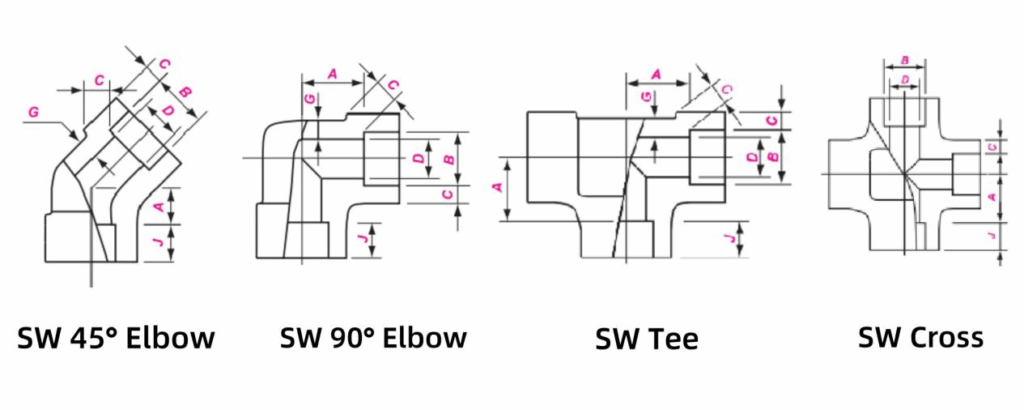
| Nominal Size | Socket Bore Dia. | Bore Dia. of Fittings | Socket Wall Thickness | Body Wall | Depth of Socket | Center to Bottom of Socket | |||||||||||||||
| DN | NPS | B | D | C | G min | J min | A | ||||||||||||||
| 3000 | 6000 | 9000 | 3000 | 6000 | 9000 | 3000 | 6000 | 9000 | 90 Elbow,Tee,Cross | 45 Elbow | |||||||||||
| ave | min | ave | min | ave | min | 3000 | 6000 | 9000 | 3000 | 6000 | 9000 | ||||||||||
| 6 | 1/8 | 10.9 | 6.1 | 3.2 | 3.18 | 3.18 | 3.96 | 3.43 | 2.41 | 3.15 | 9.5 | 11 | 11 | 8 | 8 | ||||||
| 8 | 1/4 | 14.3 | 8.5 | 5.6 | 3.78 | 3.3 | 4.6 | 4.01 | 3.02 | 3.68 | 9.5 | 11 | 13.5 | 8 | 8 | ||||||
| 10 | 3/8 | 17.7 | 11.8 | 8.4 | 4.01 | 3.5 | 5.03 | 4.37 | 3.2 | 4.01 | 9.5 | 13.5 | 15.5 | 8 | 11 | ||||||
| 15 | 1/2 | 21.9 | 15 | 11 | 5.6 | 4.67 | 4.09 | 5.97 | 5.18 | 9.53 | 8.18 | 3.73 | 4.78 | 7.47 | 9.5 | 15.5 | 19 | 25.5 | 11 | 12.5 | 15.5 |
| 20 | 3/4 | 27.3 | 20.2 | 14.8 | 10.3 | 4.9 | 4.27 | 6.96 | 6.04 | 9.78 | 8.56 | 3.91 | 5.56 | 7.82 | 12.5 | 19 | 22.5 | 28.5 | 13 | 14 | 19 |
| 25 | 1 | 34 | 25.9 | 19.9 | 14.4 | 5.69 | 4.98 | 7.92 | 6.93 | 11.38 | 9.96 | 4.55 | 6.35 | 9.09 | 12.5 | 22.5 | 27 | 32 | 14 | 17.5 | 20.5 |
| 32 | 11/4 | 42.8 | 34.3 | 28.7 | 22 | 6.07 | 5.28 | 7.92 | 6.93 | 12.14 | 10.62 | 4.85 | 6.35 | 9.7 | 12.5 | 27 | 32 | 35 | 17.5 | 20.5 | 22.5 |
| 40 | 11/2 | 48.9 | 40.1 | 33.2 | 27.2 | 6.35 | 5.54 | 8.92 | 7.8 | 12.7 | 11.12 | 5.08 | 7.14 | 10.15 | 12.5 | 32 | 38 | 38 | 20.5 | 25.5 | 25.5 |
| 50 | 2 | 61.2 | 51.7 | 42.1 | 37.4 | 6.93 | 6.04 | 10.92 | 9.5 | 13.84 | 12.12 | 5.54 | 8.74 | 11.07 | 16 | 38 | 41 | 54 | 25.5 | 28.5 | 28.5 |
| 65 | 21/2 | 73.9 | 61.2 | 8.76 | 7.62 | 7.01 | 16 | 41 | 28.5 | ||||||||||||
| 80 | 3 | 89.9 | 76.4 | 9.52 | 8.3 | 7.62 | 16 | 57 | 32 | ||||||||||||
| 100 | 4 | 115.5 | 100.7 | 10.69 | 9.35 | 8.56 | 19 | 66.5 | 41 | ||||||||||||
Main Application Areas
Oil and gas industry: pipelines, valves, pumps, separators, etc. used in oil and gas extraction, transportation and refining equipment, especially in the environment containing hydrogen sulfide, chloride and other corrosive media.
Chemical industry: various chemical containers, piping systems, heat exchangers, reactors, etc., dealing with acid, alkali, salt and other corrosive chemicals.
Marine engineering and desalination: structural parts of offshore platforms, submarine pipelines, pumps, valves and piping systems in desalination equipment, due to its excellent resistance to chloride corrosion.
Pulp and paper industry: for bleaching equipment, digesters, scrubbers, etc., which are often exposed to chlorine and acidic environments.
Environmental protection and pollution control: Flue gas desulphurization (FGD) systems, wastewater treatment plants, etc.
Structural components: Due to its high strength and corrosion resistance, it is also used in bridges, building structures and highly stressed components.
You can get an offer for products in below material forms:
-Pipe and Tube (EN 10216-5, ASTM A213, ASTM A249, A312, A790,)
-Forged Fitting and Flange (ASTM A182 , ASTM A105,ASTM B564 )
-Butt Weld Fittings (ASTM A234, ASTM A403,ASTM A815)
-Round bar , Billet (ASTM A276, ASTM A479)
– Plate, Sheet, Strip(ASTM A240, EN 10028-7, A480)
-Bolting, Nuts(ASTM A193, A194, A320)
Duplex Steels Forged Fittings Exported Countries
We Export Duplex steels S31803 & S32205 Forged Fittings to Saudi Arabia, United Arab Emirates, Qatar, Bahrain, Oman, Kuwait, Turkey, Egypt, Yemen , Syria, Jordan, Cyprus, Singapore, Malaysia, Indonesia, Thailand, Vietnam, South Korea, Japan, Sri Lanka, Maldives, Bangladesh, Cambodia, Argentina, Bolivia, Brazil, Venezuela, Colombia, Ecuador, Guyana, Paraguay, Uruguay, United States Of America, Canada, Mexico, Panama, Jamaica, Bahamas, Denmark, Norway, Germany, France,Italy, United Kingdom, Spain, Belgium, Greece, Czech Republic, Portugal, Hungary, Albania, Austria, Finland, Ireland, Croatia, Malta, Nigeria, Algeria, Angola, South Africa, Libya, Egypt, Sudan, Europe, Africa, Asia, North America, South America, Middle East.etc