
Aluminum 6063 is a typical aluminum-magnesium-silicon alloy (Al-Mg-Si series) with excellent extrudability, superior surface treatment properties, and moderate strength. 6063 aluminum has certain mechanical properties and is classified as medium strength. Although it is corrosion resistant, it has better processing performance than other materials. It is widely used in industrial and construction fields, especially suitable for making profiles and structural parts.
ZIZI specialize in selling all kinds of pipe fittings, tubes, plates, flanges, bolts and nuts, our products are widely used in many fields, from precision machinery manufacturing to warm home decoration and even high-end aerospace industry. We have become a trusted choice for many industries due to our superior product quality and wide range of applications. Not only do we offer a wide range of products, but we can also provide customized processing services according to the specific needs of our customers, ensuring that your expectations are accurately met every time we work together. With advanced production equipment and strict quality management system, we are committed to providing high-quality piping solutions to customers worldwide. Welcome to contact us.
Composition Composition Specification (%)
Magnesium and silicon are key to forming the Mg2Si strengthening phase, directly impacting the alloy’s strength and heat-treatment strengthening effects.
Iron is a common impurity element; excessive levels can reduce the alloy’s plasticity and surface quality.
Strict control of other trace elements also impacts the alloy’s overall performance.
| Alloy | Si | Fe | Cu | Mn | Mg | Cr | Zn | Ti | Other | |
| Each | Total | |||||||||
| 6063 | 0.2-0.6 | 0.35 | 0.1 | 0.1 | 0.45-0.9 | 0.1 | 0.1 | 0.1 | 0.05 | 0.15 |
Mechanical Property Specification
6063 has good elongation and a yield strength of 8-12%, giving it good ductility for extrusion. Due to these properties, it is easy to manufacture aerospace structures, building frames and pipes.
| Alloy and Temper | Thickness mm | Tensile Strength | Elongation (% min in 50mm) | ||||
| Over | Up to | Ultimate | Yield | ||||
| Min | Max | Min | Max | ||||
| 6063 T1 | <12mm | 115 | – | 60 | – | 12 | |
| 6063 T4 | <150mm | 130 | – | 70 | – | 12 | |
| 6063 T5 | <12mm | 150 | – | 110 | – | 8 | |
| 6063 T6 | <25mm | 205 | – | 170 | – | 8 | |
Grade Specification Comparison
| Alloy | UNS No | ISO | BS | DIN | |
| No | Name | ||||
| 6063 | A96063 | AlMgSi | H19 | 3.3206 | AlMgSi0.5 |
These comparisons are approximate only. The list is intended as a comparison of functionally similar materials not as a schedule of contractual equivalents. If exact equivalents are needed original specifications must be consulted.
Various States of Aluminum Alloy
| State Name | Description |
| H – Work Hardened State | Applies to products strengthened by work hardening, which may or may not undergo additional heat treatment to slightly reduce strength. |
| O – Annealed State | Applies to processed products that have been fully annealed to achieve the lowest strength. |
| T – Thermally Treated State (different from F, O, H states) | Applies to products that have been thermally treated and may or may not undergo work hardening to achieve stability. The letter “T” must be followed by one or more Arabic numerals (typically for heat-treatable materials). |
| W – Solution Heat Treated State | An unstable state, only applicable to alloys that have undergone solution heat treatment and natural aging at room temperature. This state code indicates the product is in the natural aging stage. |
| F – Free Machining State | Applies to products where no specific requirements for work hardening or heat treatment conditions are imposed during forming. The mechanical properties of products in this state are not specified. |
Different tempering conditions for Al 6063
6063-O: Annealed Form
To produce Al 6063-O, annealing is performed at 413°C. At 413°C, the material is held for 2 to 3 hours, then cooled at a rate of 50°F per hour from 775°F to 500°F. After heat treatment, a tensile strength of 89.6 MPa can be achieved.
6063-T1: Strain-hardened type
Since it is a heat-treatable alloy, strain hardening is not possible. To produce Al 6063-T1, it is first subjected to solution heat treatment at 520–540°C, followed by natural aging at room temperature. After this process, a strength of 152 MPa can be achieved.
6063-T4: Solution Heat Treatment
To produce Al 6063-T4 in the annealed state, Al 6063 is first subjected to solution heat treatment (520–540°C), quenched, and then naturally aged. This annealing process achieves a strength of 172 MPa.
6063-T5: Aging and Tensile Testing
In this type of tempering, stretching is performed to release internal stress. To temper Al 6063-T5, it is first cooled at (480–500°C), stretched by 3–5%, and then artificially aged at 175–200°C. This tempering process achieves a tensile strength of 186 MPa.
6063-T6: Solution Heat Treatment and Artificial Aging
The same procedure as the first solution involves heat treatment, cooling, and artificial aging at 175–200°C. This condition has higher mechanical properties than the aforementioned condition. This heat treatment produces a smooth surface.
6063 Aluminum Alloy Weldability
6063 aluminum alloy is renowned for its excellent weldability, particularly when using tungsten inert gas welding (TIG) or metal inert gas welding (MIG). This alloy has a lower copper content than other alloys, thereby reducing the risk of hot cracks during welding. To enhance the alloy’s strength and hardness, post-welding heat treatment may be required. For optimal results, the filler alloy should be compatible with the aluminum 6063.
6063 Aluminum Alloy Machinability
Aluminum 6063 offers good machinability and moderate strength, making it ideal for mechanical processing. Its turning, milling, and drilling capabilities can be achieved through standard machining processes. To achieve high precision and quality, sharp cutting tools should be used, along with appropriate cutting speeds and feed rates, which also enhance the strength of the final product. Coolant used during machining helps control temperature rise and reduce tool wear. Additionally, due to the alloy’s lower hardness, special attention should be paid to surface deformation caused by deformation during machining, particularly when processing thin-walled parts.
Aluminum 6063 Extrusion Process
When extruding 6063 aluminum, the aluminum alloy is forced through a die to achieve a specific cross-sectional area. This process is carried out at high temperatures to soften the material and make it easier to pass through the die. The extrusion process enhances the material’s strength, uniformity, and precision. Additionally, it produces lightweight, corrosion-resistant profiles to meet various application requirements, particularly in the construction and manufacturing industries, fully demonstrating the versatility of 6063.
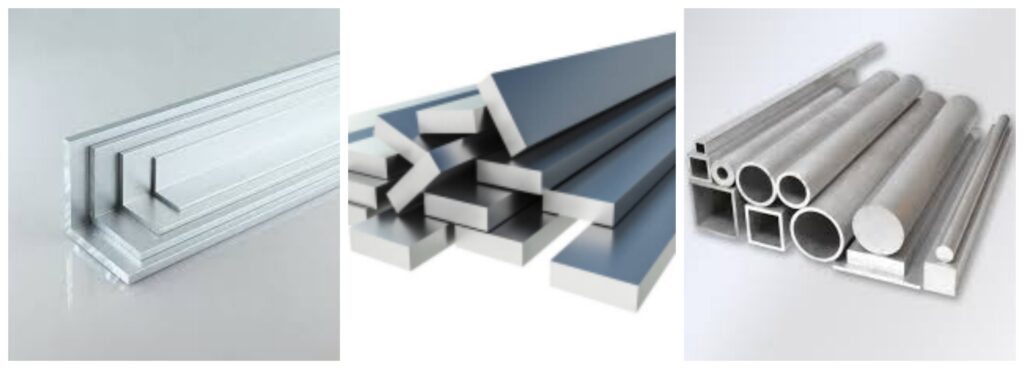
Supplied Forms
Sheets
Bars
Tubes
Profiles
Coils
Strips
Applications
Architectural Profiles: Windows, Doors, Curtain Walls, Sun Rooms, Frame Structures
Industrial Profiles: Mechanical Frames, Automation Equipment Structural Components
Automotive and Rail Transit: Flooring, Insulation Structures, Window Frames
Appliance Housings: TV Frames, Speaker Housings, Lighting
Furniture and Decorative Components: Office Desks, Display Stands, Decorative Strips
You can get an offer for products in below material forms:
-Pipe and Tube (EN 10216-5, ASTM A213, ASTM A249, A312, A790,)
-Forged Fitting and Flange (ASTM A182 , ASTM A105,ASTM B564 )
-Butt Weld Fittings (ASTM A234, ASTM A403,ASTM A815)
-Round bar , Billet (ASTM A276, ASTM A479)
– Plate, Sheet, Strip(ASTM A240, EN 10028-7, A480)
-Bolting, Nuts(ASTM A193, A194, A320)