
BSP stands for British Standard Pipe, which is a widely adopted thread standard internationally, primarily used for connecting and sealing pipes and fittings. While NPT (National Pipe Taper) threads are predominantly used in North America, BSP thread is widely used in many other countries and regions around the world, including the United Kingdom, most of Europe, Asia, and Commonwealth countries.
ZIZI specialize in selling all kinds of stainless steel pipe fittings, tubes, plates, flanges, bolts and nuts, our products are widely used in many fields, from precision machinery manufacturing to warm home decoration and even high-end aerospace industry. We have become a trusted choice for many industries due to our superior product quality and wide range of applications. Not only do we offer a wide range of products, but we can also provide customized processing services according to the specific needs of our customers, ensuring that your expectations are accurately met every time we work together. With advanced production equipment and strict quality management system, we are committed to providing high-quality piping solutions to customers worldwide. Welcome to contact us.
Types of BSP Thread
BSP threads are divided into three types: BSPP (British Standard Pipe Parallel), BSPT (British Standard Pipe Taper), and BSPF (British Standard Pipe Fine).
BSPT – Tapered Thread

Designation: Male threads are denoted by R (e.g., R 1/2″). Female threads can be parallel (Rp) or tapered (Rc), though tapered female threads are less common in practice.
Shape: Male threads are tapered (conical) with a 1:16 taper ratio. The diameter gradually increases along the length.
Sealing Method: Sealing is achieved by the metal-to-metal interference (wedging action) when the tapered male thread is screwed into a corresponding female thread. As they tighten, the threads deform slightly to create a pressure-tight seal.
| R | Designation of taper external thread. |
| Rp | Designation of parallel internal thread. |
| P | Pitch |
| H | Height of the triangle of the thread profile perpendicular to the thread axis. |
| h | =0,640327P,height of the thread profile between rounded crests and roots perpendicular to the thread axis |
| r | Radius of rounded crests and roots |
| D | Major diameter of the internal thread at the gauge plane(gauge diameter-see 3.1) |
| D₁ | =D-1,280654P,minor diameter of the internal thread at the gauge plane |
| D₂ | =D-0,640327 P,pitch diameter of the internal thread at the gauge plane |
| d | Major diameter of the external thread at the gauge plane(gauge diameter-see 3.1) |
| d₁ | =d-1,280654P,minor diameter of the external thread at the gauge plane |
| d₂ | =d-0,640327P;pitch diameter of the external thread at the gauge plane |
| T₁ | Tolerance on the gauge length of an external thread |
| T₂ | Tolerance for the position of the gauge plane on an internal thread |
| La | Accommodation length(see 7.2.2) |
| L | Useful thread length for intenally threaded workpieces(see 7.2.2) |
| L。 | Useful thread length for externally threaded workpieces(see 7.2.2) |
As can be seen, British standard sealed pipe threads are generally divided into two types: cylindrical pipe threads and tapered pipe threads.
Sealing cylindrical pipe threads (Rp) have the same thread profile as non-sealing pipe threads (G), but differ in thread precision. Sealing tapered pipe threads (R) are technically converted from cylindrical pipe threads with a taper ratio of 1:16.
BSPP – Parallel Thread
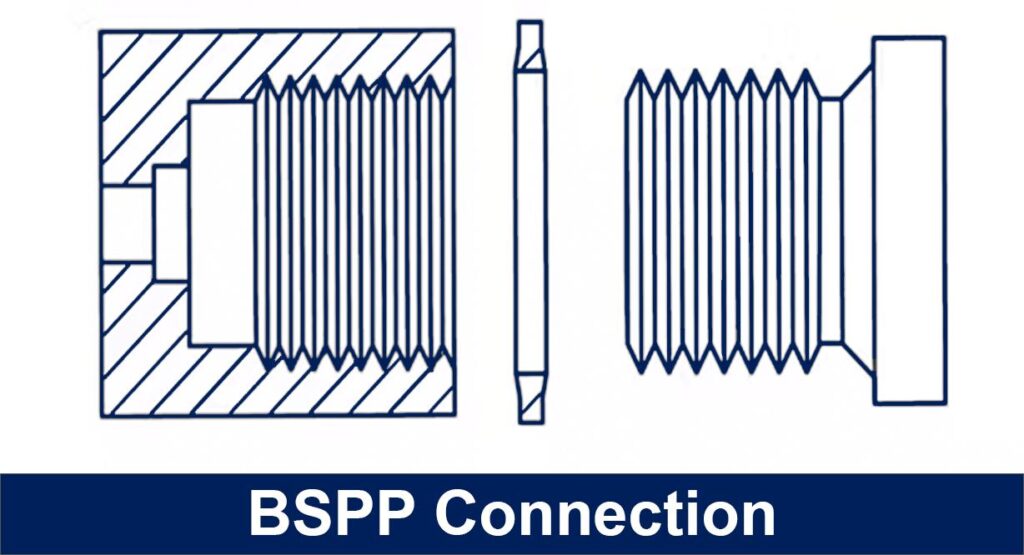
Designation: Often denoted by the letter G (e.g., G 1/2″).
Shape: Both male and female threads are cylindrical or parallel, meaning their diameter remains constant along the length.
Sealing Method: Since the threads are parallel, they do not create a seal by themselves through thread deformation. Instead, sealing is achieved by:
Compression of a soft material: An O-ring, bond washer, or gasket is compressed between the end face of the male thread and a mating surface (e.g., the face of a female port or a fitting).
PTFE tape or liquid sealant: Can be used as an additional measure to prevent leaks.
BSPP (British Standard Parallel Thread) is a 55° parallel thread for sealed connections. In the VPC series of tube fittings, BSPP threads are equipped with O-rings by default.
BSP Thread Standards and Specifications
ISO 7 (BS 21, EN 10226-1): This standard specifies pipe threads where pressure-tight joints are made on the threads themselves, primarily applying to BSPT (British Standard Pipe Taper) threads. It ensures the taper angle (1:16) and thread profiles are consistent for reliable sealing under pressure.
ISO 228 (BS 2779, DIN 259): This standard specifies pipe threads where pressure-tight joints are not made on the threads, applying to BSPP (British Standard Pipe Parallel) threads. The focus here is on consistent dimensions and profiles, allowing for sealing through external means like O-rings or sealing washers.
BSP Thread Dimension
| Thread size | Number of threads in 25,4 mm | Pitch | Height of thread | Diameters at gauge plane | Gauge length (external thread) | Assembly length | Length of useful external thread not less than | |||||||
| P mm | h mm | Major (gauge diameter) d=D mm | Pitch d₂=D₂ mm | Minor d=D₁ mm | Nominal mm | max. mm | min. mm | mmb | Turns of thread | For nominal gauge length mm | For maximum gauge length mm | For minimum gauge length mm | ||
| 1/16 | 28 | 0.907 | 0.581 | 7.723 | 7.142 | 6.561 | 4 | 4.9 | 3.1 | 25 | 2.3/4 | 6.5 | 7.4 | 5.6 |
| 1/8 | 28 | 0.907 | 0.581 | 9.728 | 9.147 | 8.568 | 4 | 4.9 | 3.1 | 25 | 2.3/4 | 6.5 | 7.4 | 5.6 |
| 1/4 | 19 | 1.337 | 0.858 | 13.157 | 12.301 | 11.445 | 6 | 7.3 | 47 | 3.7 | 2.3/4 | 9.7 | 11 | 8.4 |
| 3/8 | 19 | 1.337 | 0.855 | 16.662 | 15.805 | 14.950 | 6.4 | 7.7 | 5.1 | 3.7 | 2.3/4 | 10.1 | 11.4 | 8.8 |
| 1/2 | 14 | 1.814 | 1.162 | 20.955 | 19.793 | 18.631 | 8.2 | 10 | 6.4 | 5 | 2.3/4 | 13.2 | 15 | 114 |
| 3/4 | 14 | 1.814 | 1.162 | 26.441 | 25279 | 24.117 | 9.5 | 11.3 | 7.7 | 5 | 2.3/4 | 145 | 16.3 | 127 |
| 1 | 11 | 2,309 | 1.479 | 33.249 | 31.770 | 30.291 | 10.4 | 12.7 | 8.1 | 6.4 | 2.3/4 | 16.8 | 19.1 | 14.5 |
| 1 1/4 | 11 | 2.309 | 1.479 | 41.91 | 40.431 | 38.952 | 12.7 | 15 | 10.4 | 6.4 | 2.3/4 | 19.1 | 21.4 | 16.8 |
| 1 1/2 | 11 | 2.309 | 1.479 | 47.803 | 46.324 | 44.845 | 127 | 15 | 10.4 | 6.4 | 2.3/4 | 191 | 214 | 16.8 |
| 2 | 11 | 2.309 | 1.479 | 59.614 | 58.135 | 56.658 | 15.9 | 18.2 | 136 | 7.5 | 3.14 | 234 | 25.7 | 21.1 |
| 2 1/2 | 11 | 2.309 | 1.479 | 75.184 | 73.705 | 72.228 | 17.5 | 21 | 140 | 9.2 | 4 | 26.7 | 30.2 | 232 |
| 3 | 11 | 2.309 | 1.479 | 87.884 | 86.405 | 84.928 | 20.6 | 24.1 | 17.1 | 9.2 | 4 | 298 | 33.3 | 26.3 |
| 4 | 11 | 2.309 | 1.479 | 113.030 | 115.551 | 110.072 | 25.4 | 28.9 | 21.9 | 10.4 | 4.12 | 35.8 | 39.3 | 32.3 |
| 5 | 11 | 2.309 | 1.479 | 138.430 | 136.951 | 135.472 | 28.6 | 32.1 | 25.1 | 11.5 | 5 | 40.1 | 43.6 | 365 |
| 6 | 11 | 2.309 | 1.479 | 163.83 | 162.351 | 180.872 | 28.6 | 32.1 | 25.1 | 11.5 | 5 | 40.1 | 43.6 | 365 |
Features and Advantages
High Versatility: As one of the internationally recognized pipe thread standards, BSP threads are widely adopted in industrial equipment and piping systems across many countries and regions, facilitating interchangeable connections between fittings produced by different manufacturers.
Reliable Sealing: Especially the BSPT tapered pipe thread, which achieves effective sealing through its own tapered fit, thereby reducing leakage issues caused by seal failure; BSPP parallel threads, though requiring auxiliary seals, also ensure good sealing performance when properly installed.
Mature Manufacturing Processes: After years of application and development, BSP thread manufacturing technology has become highly mature, with related manufacturing equipment and gauges widely available, capable of meeting the demands of large-scale production and high-precision processing.
How to identify and measure BSP threads
Since the nominal dimensions of BSP threads do not match their actual measured dimensions, the following precautions should be taken when identifying and measuring them:
Thread measurement: Use a vernier caliper to measure the outer diameter (major diameter) of the thread and the number of threads per inch (TPI). Then compare the measurements with the BSP thread size reference table.
Thread Gauge: The most accurate method is to use a **thread gauge to inspect the thread profile, pitch, and angle.
Differences Between BSP and NPT Threads
BSP and NPT are the two most common pipe thread standards, and their key differences are as follows:
Thread Angle: BSP is 55 degrees, while NPT is 60 degrees.
Thread Profile: BSP has rounded peaks and valleys, while NPT has flat peaks and valleys.
Taper: BSPT has a taper (1:16), and NPT also has a taper (1:16), but the thread angles differ, making them incompatible.
Sealing method: BSPP relies on auxiliary sealing, BSPT relies on thread compression plus auxiliary sealing; NPT primarily relies on thread compression.
Application Areas
Water supply and drainage systems: Connections for water pipes, faucets, valves, etc. in daily life and industry.
Hydraulic and pneumatic systems: Connections for various hydraulic hoses, pneumatic pipes, and components.
Gas pipelines: Used for gas transportation and equipment connections.
Industrial equipment: Widely used in fluid connections for various machinery, equipment, and instruments.