
Elbows are pipe fittings used to change the direction of pipes in pipe systems. They enable pipes to be connected in different directions to meet various complex pipe layout requirements. Elbows can be divided into 45 degree elbow and 90 degree elbow according to their angles
What is 45 Degree Elbow?
A 45 degree elbow is a pipe fitting used to change the direction of a pipe in a pipe system. It can change the direction of the pipe by 45 degrees. It is an important member of the elbow pipe fitting family. It usually made of various materials, such as carbon steel elbow, stainless steel elbow, alloy steel elbow, etc.
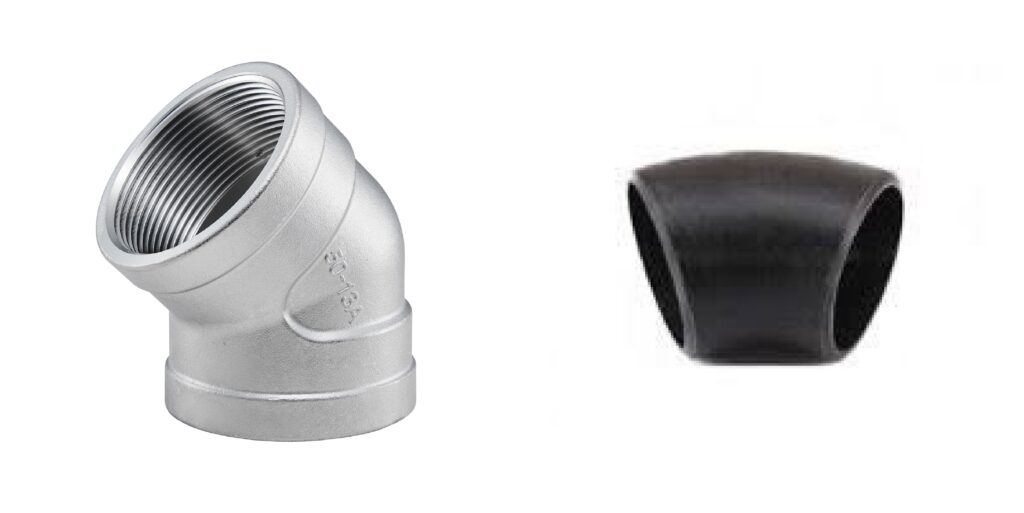
Characteristics
Fluid Resistance:45 degree elbows have less resistance to fluid. When the fluid flows through a 45-degree elbow, the flow state of the fluid is less disturbed due to the relatively gentle turning angle.
Reduce Turbulence:The 45 degree turning angle helps reduce the possibility of turbulence in the elbow.
Uniform Stress Distribution:The stress distribution at the 45 degree elbow is relatively uniform.
Application
Construction Industry:In the water supply and drainage system of buildings, 45 degree elbows are widely used.
Petrochemical Industry:45 degree elbows are used to connect pipelines between various equipment.
Power Industry:In the thermal system of thermal power plants, 45 degree elbows can be used to change the direction of pipelines.
What is 90 Degree Elbow?
The 90 degree Elbow is a common pipe fitting used to change the direction of the pipe in the pipe system. Its shape is similar to a right-angle elbow, with connection interfaces at both ends. It can be connected with pipes and pipe fittings of different materials to build a complex pipe network.
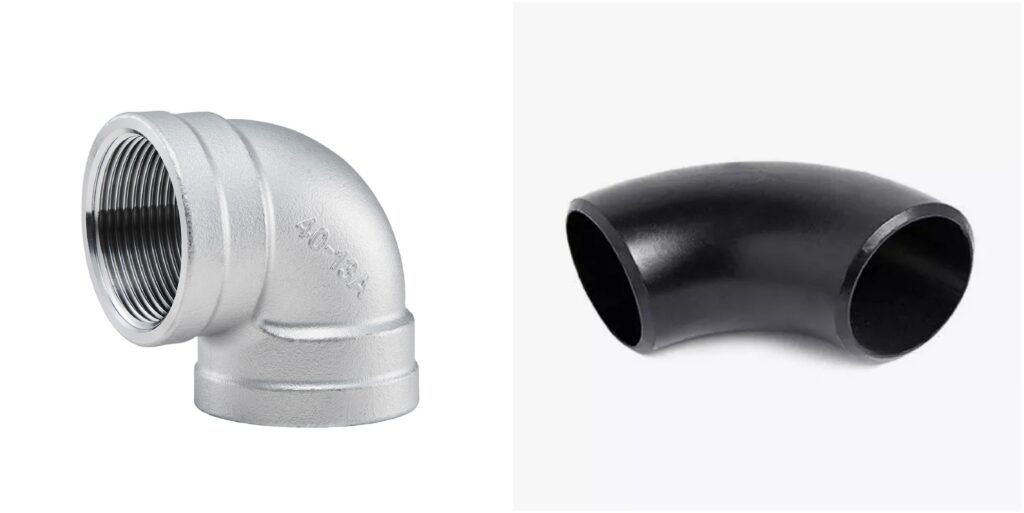
Characteristics
Shape and Structural : Precise 90 degree bending angle. It can ensure accurate vertical steering in the pipeline layout.
Fluid Mechanics : It can achieve a complete change in the flow direction of the pipeline.
Mechanical Properties: The 90 degree elbow needs to have a certain pressure bearing capacity considering its role in the pipeline system.
Application
Plumbing and Drainage: Commonly used in wastewater systems for directional changes.
Petrochemical Industry: In the pipeline system of petrochemical enterprises, 90 degree elbows are used to connect pipelines between various equipment to change the direction of the pipeline.
Power Industry: In the steam-water system of thermal power plants, 90-degree elbows are used to connect pipelines between boilers, steam turbines, condensers and other equipment to change the direction of oil pipelines.
45 Degree Elbow vs 90 Degree Elbow
Angle Difference
A 45 degree elbow changes the direction of the pipe by 45 degrees, while a 90 degree elbow changes the direction of the pipe by 90 degrees. This is the most intuitive difference between the two, and this angle difference directly affects their application scenarios and functions in the pipeline system.
Flow Characteristics
🔹45 Degree Elbow: Offers smoother flow with less turbulence and pressure drop. It is often used in systems where maintaining flow efficiency is essential.
🔹90 Degree Elbow: Causes more turbulence and pressure loss, which may be acceptable in systems with adequate pressure handling capacity.
Space Requirements
When choosing between a 45-degree elbow and a 90-degree elbow, understanding the space requirements is essential for proper piping layout and installation.
🔹 45-Degree Elbow:
A 45-degree elbow has a smoother and more gradual bend, which means it requires more installation space along the pipeline. The extended curvature allows for a gentler flow transition, reducing turbulence and pressure loss — making it ideal for systems where flow efficiency is prioritized over compactness.
🔹 90-Degree Elbow:
A 90-degree elbow, on the other hand, has a sharper turn and is more space-efficient, making it suitable for tight or confined areas where space is limited. However, the sudden change in direction can cause higher turbulence and pressure drop compared to a 45-degree elbow.
In summary, 45-degree elbows are preferred when flow performance matters, while 90-degree elbows are chosen when space optimization is the key consideration.
Conclusion of 45 Degree Elbow vs 90 Degree Elbow
The difference between 45-degree and 90-degree elbows lies in their angle of bend, flow characteristics, space requirements, and applications. Each type of elbow offers unique benefits, catering to different needs and environments.