
ButtWeld fittings are widely used connection components in pipeline systems, primarily connecting two sections of pipe through welding. These fittings are ingeniously designed to ensure the stability and sealing of pipe connections, thereby playing a critical role in various industrial environments. Welded pipe fittings are primarily used in high-pressure pipeline systems requiring high pressure resistance, precision-sized equipment, and other high-pressure applications across industries such as petrochemicals, pharmaceuticals, healthcare, power generation, aerospace, defense, fire protection, metallurgy, shipbuilding, natural gas, nuclear power, and environmental protection.
Types of Buttweld Fittings
Buttweld Elbow:
One of the most commonly used fittings in piping systems, primarily used to change the direction of fluid flow. They are connected to pipes or other fittings via butt welding, forming a seamless, sturdy, and leak-proof structure.
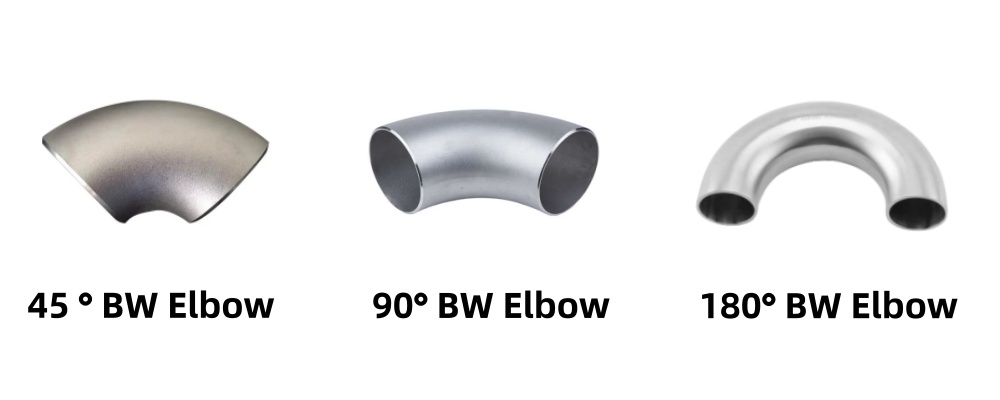
Based on the bending angle, common types include 45° elbows, 90° elbows, and 180° elbows.
· 45° elbows are suitable for scenarios requiring a smaller angle of turn, enabling pipes to change direction in a compact space and reduce fluid flow resistance.
· 90° elbows are the most common type, often used at right-angle turns, such as in building plumbing systems where 90° elbows are employed to redirect pipes at wall corners;
· 180° elbows, also known as U-bends, enable pipes to make a 180° return, playing a role in processes where fluid needs to be redirected back to the starting point or a specific location.
Based on curvature radius, elbows can be further classified into long-radius elbows (Long Radius Elbow) and short-radius elbows (Short Radius Elbow).
· Long Radius Elbow: Its bending radius is 1.5 times the pipe diameter (R=1.5D). This type of elbow has low fluid resistance and is commonly used in applications requiring smooth fluid flow.
· Short Radius Elbow: Its bending radius is equal to the pipe diameter (R=1D). This type of elbow is space-efficient and suitable for applications with limited installation space, but it has relatively higher fluid resistance.
Buttweld Tee
A buttweld tee is a common type of pipe fitting. It is shaped like a “T” and is used to branch off a secondary pipe from the main pipeline, thereby achieving the diversion or convergence of fluid flow. It is connected to the pipeline via butt welding, forming a sturdy, sealed, and continuous structure to ensure no leakage occurs during the transportation of high-pressure, high-temperature, or corrosive media. Welded tees are classified into equal tees (all ports have the same diameter) and reducing tees (the branch pipe diameter is smaller than the main pipe diameter) based on whether the three ports have the same diameter. They are widely used in various industrial pipeline systems such as petroleum, chemicals, power, and construction.
Buttweld Cross:
Buttweld cross is a special type of welded pipe fitting shaped like a “cross,” primarily used to connect four pipes at a single point, enabling fluid to diverge or converge in four directions.crosses have four outlets of the same or different diameters, all designed for welded connections to ensure a robust, leak-proof pipeline system.
Buttweld Reducers:
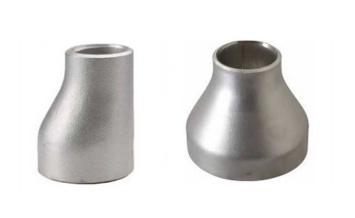
Buttweld reducers, also commonly referred to as welded reducer pipes, are an important type of welded pipe fitting primarily used to connect two pipes of different diameters, facilitating smooth transition and flow adjustment of the fluid medium within the pipeline system. They are directly welded to the pipes via their beveled ends, forming a secure, leak-proof connection that aligns flush with the inner wall of the pipe, thereby reducing fluid resistance. Based on whether the centerlines of the connected pipes are aligned, butt-welded reducers can be classified into concentric reducers and eccentric reducers.
Buttweld Caps:
Buttweld caps are an important type of pipe connection component primarily used to seal the ends of pipe systems. Their design features no internal threads or socket connections but instead uses a beveled groove to directly butt-weld with the pipe, forming a seamless and highly sealed end. This connection method ensures the structural integrity, high strength, and excellent leak-proof performance of the pipe system, enabling it to withstand the transmission of high-pressure, high-temperature, or corrosive media.
Buttweld Stub Ends
One end of the lap joint stub end features a flanged design with a flange, while the other end is welded to the pipeline. It is used in conjunction with a loose flange, enabling more flexible pipe connections that are easy to disassemble and install. This configuration is suitable for pipe connections that require frequent maintenance or equipment replacement. In the piping systems of offshore oil drilling platforms, where equipment requires regular maintenance and replacement, the combination of lap joint stub ends and loose flanges is widely adopted, effectively enhancing maintenance efficiency.
Material & Grades of Buttweld Fittings
Carbon Steel Buttweld Fittings:
ASTM A234 WPB / WPC,ASTM 420 WPL 3 / 6 / 9,A860 WPHY 42 / 46 / 52 / 56 / 65 / 70
Alloy Steel Buttweld Fittings:
A234 WP5 / WP9 / WP11 / WP12 / WP22 /WP 91 / WP92
Stainless Steel Buttweld Fittings:
A403 WP304/304L/304H – WP316/316L – WP317 – WP310S – WP321 – WP347 – WP904L
Duplex & Super Duplex Steel Buttweld Fittings:
A815 WPS32205/32750/31803/32760
Manufacturing Method of Buttweld Fittings
Manufacturing Methods for Elbows
1. Hot Push Forming Method (Hot Push Forming)
The pipe material is heated to a certain temperature, then pushed through a die to bend it, while simultaneously performing diameter compensation forming. This method is suitable for medium to large diameter, thick-walled elbows, offering high forming efficiency and good continuity of fiber structure.
2. Cold Bending Method
A specialized bending machine is used to bend straight pipes at room temperature.
Manufacturing Methods for Tees
1. Hydraulic Bulging Method
Hydraulic oil is injected into a closed pipe section, causing the middle section to expand into a tee branch. This method ensures uniform wall thickness and is suitable for thin-walled pipes.
2. Hot Extrusion Method
The tube blank is heated, and the branch opening is punched out from the side using a specialized die, followed by die shaping. This method can produce large-diameter, thick-walled tees.
Manufacturing Methods for Reducers
The tube material is placed in a reducer die and pressed into a reducer shape using hydraulic or mechanical pressure.
Manufacturing Methods for Pipe Caps (Cap):
Mostly produced using press forming or integral stamping. For thick-walled pipe caps, multiple stamping operations or welding may be required.
Manufacturing Methods for Lap Joint Stub Ends
Generally produced using a combination of machined flanging and welded short tubes, or through integral forging or press forming.
Advantages of Buttweld Fittings
High weld strength and robust structure
Leak-resistant with excellent sealing performance
Smooth transition at connections with minimal fluid resistance
Capable of withstanding high-temperature and high-pressure environments
Long service life and low maintenance costs
Application Areas
Petroleum refining plant pipeline systems
Natural gas transmission pipelines
Power plant boilers and heat exchange systems
Chemical process pipelines
Food and pharmaceutical clean systems (stainless steel material)