
Among the many types of stainless steel, 904L stainless steel stands out for its excellent corrosion resistance and superior mechanical properties. As a super austenitic stainless steel, it can operate reliably in harsh industrial environments, with applications ranging from chemical equipment to marine engineering. This article provides a comprehensive analysis of 904L stainless steel, helping you gain a deeper understanding of its performance advantages, primary application areas, and key considerations when selecting materials.
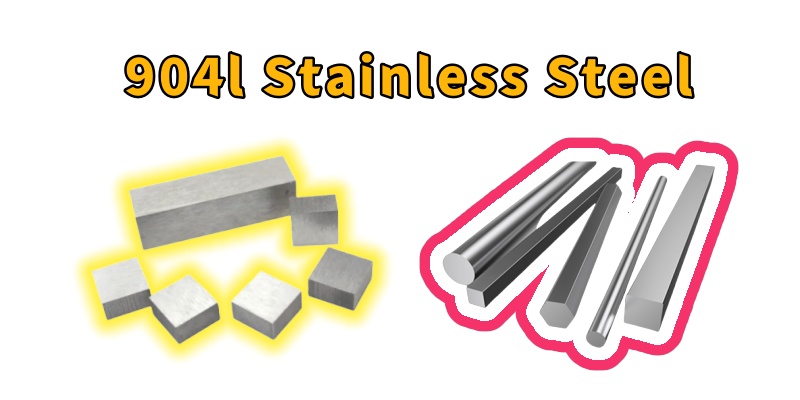
What is 904L Stainless Steel?
904L (UNS N08904, European material number 1.4539) is a high-alloy super austenitic stainless steel characterized by a high nickel (Ni) + high molybdenum (Mo) + low carbon (L) + copper (Cu) alloy composition. This combination confers exceptional resistance to pitting corrosion, crevice corrosion, and stress corrosion cracking in sulfuric acid, phosphoric acid, chloride environments, and marine conditions. It is often used as an upgraded alternative to 316L and can partially replace higher-cost nickel-based alloys in certain media.
904L Stainless Steel Composition
The primary chemical components of 904L stainless steel include carbon (C), silicon (Si), manganese (Mn), phosphorus (P), sulfur (S), nickel (Ni), chromium (Cr), and copper (Cu). Among these, nickel and chromium are the core elements that confer the material’s exceptional corrosion resistance and high-temperature performance, while the small amount of copper significantly enhances its corrosion resistance in highly corrosive environments such as sulfuric acid and phosphoric acid.
| CHEMICAL | LIMITS | C | Mn | P | S | Si | Ni | Cr | Mo | N |
| 904L | MIN | 23 | 19 | 4 | ||||||
| MAX | 0.02 | 2 | 0.04 | 0.03 | 1 | 28 | 23 | 5 | 0.1 |
904L Stainless Steel Mechanical Properties
| Mechanical Properties | Data |
| Yield Strength, min. (Mpa) | 215 |
| Tensile Strength, min. (Mpa) | 490 |
| Elongation, min. | 35% |
| Hardness, max. (HRB) | 90 |
904L Stainless Steel Physical Properties
| Grade | Density (Kg/M 3 ) |
Elastic Modulus (GPa) |
Mean Co-Eff Of Thermal Expansion (Μm/M/°C) 0-100°C |
Thermal Conductivity (W/M.K) At 20°C |
Specific Heat 0-100°C (J/Kg.K) |
Elec Resistivity (NΩ.M) |
| 904L | 7900 | 190 | 15 | 11.5 | 500 | 952 |
904L Stainless Steel Equivalents
| AISI | UNS | DIN | EN |
| 904L | N08904 | 1.4539 | X1NiCrMoCu25-20-5 |
Hardness of 904L Stainless Steel
The hardness of 904L stainless steel is closely related to its composition and heat treatment condition. Generally, the hardness of 904L stainless steel ranges from 150 to 200 HB. However, the hardness of 904L stainless steel can be further improved through appropriate heat treatment.
Heat Treatment of 904L Stainless Steel
The recommended working temperature for the hot working process is 1562-2102°F (850-1150°C). Typically, the next step in the hot processing sequence should be annealing and quenching. However, for 904L, if hot forming is stopped at temperatures above 2012°F (1100°C), the material can be directly quenched, allowing it to be used without further heat treatment. It is important that the entire workpiece can be quenched at temperatures above 2012°F (1100°C). When local heating or cooling is below 2012°F (1100°C), if cooling is too slow, hot working should always be followed by subsequent annealing and quenching operations. 904L should be annealed within the temperature range of 1940–2084°F (1060–1140°C).
Corrosion Resistance
This is the most prominent advantage of 904L stainless steel. It exhibits strong resistance to various corrosive media, including organic acids, inorganic acids, alkaline solutions, and salt solutions. In environments where sulfuric acid concentration does not exceed 50% and temperature does not exceed 60°C, 904L stainless steel maintains excellent corrosion resistance; in media such as phosphoric acid and acetic acid, its corrosion resistance significantly outperforms ordinary stainless steel. This makes it widely used in industries with strong corrosion, such as chemicals and pharmaceuticals.
Welding
Like most stainless steel materials, 904L can be welded using various methods. The most common welding methods are manual arc welding or gas shielded welding. The type of welding rod or wire metal depends on the composition and purity of the base metal, with the molybdenum content being higher than that of the base metal. Preheating is generally not required before welding, but in cold outdoor conditions, to prevent condensation of water vapor, the joint or adjacent areas may be uniformly heated. Care should be taken to ensure that local temperatures do not exceed 100°C to avoid carbon buildup and intergranular corrosion. During welding, a lower linear energy, continuous, and relatively fast welding speed should be used. Generally, no heat treatment is required after welding. If heat treatment is required, it should be heated to 110–1150°C and then rapidly cooled.
Processability
904L stainless steel has excellent hot and cold processing properties. It can undergo various processing operations such as stamping, bending, and welding, and is unlikely to develop cracks or fractures during processing. However, due to its higher alloy content, processing is slightly more challenging than for ordinary stainless steel, requiring appropriate processing techniques and equipment.
Comparison of 904L Stainless Steel with Other Materials
| Material Type | Corrosion Resistance | Strength & Hardness | Cost | Typical Applications |
| 904L Stainless Steel | Excellent resistance to sulfuric acid, phosphoric acid, chloride, and marine environments | High strength and toughness | Higher than 316L, lower than nickel alloys | Chemical processing equipment, marine engineering, pollution control, oil & gas industry |
| 316L Stainless Steel | Good resistance to chloride corrosion, but weaker in strong acids | Good strength | Moderate | Food processing, pharmaceutical equipment, architectural applications |
| Duplex Stainless Steel (2205) | Very good chloride resistance, good stress corrosion cracking resistance | Higher strength than 904L | Moderate | Desalination plants, chemical tankers, pulp and paper industry |
| Nickel Alloy (Alloy 625, Alloy 825) | Outstanding corrosion resistance in extreme environments | High strength at high temperatures | Much higher | Offshore platforms, chemical reactors, aerospace components |
Applications
Air pollution control — scrubbers used in coal-fired power plants
Chemical processing — processing equipment for the production of sulfuric acid, phosphoric acid, inorganic and organic acids, and phosphate fertilizers
Metallurgical processing — acid washing equipment using sulfuric acid
Oil and gas production — offshore processing equipment
Pharmaceutical industry — processing equipment
Pulp and paper — processing equipment
Seawater and brackish water — condensers, heat exchangers, and piping systems
Considerations for Selecting 904L Stainless Steel
Although 904L stainless steel offers superior performance, the following points should be considered when selecting this material.
Cost Considerations: Due to its high content of precious metals such as nickel and molybdenum, 904L stainless steel is significantly more expensive than ordinary stainless steel. Therefore, a reasonable cost assessment should be conducted while ensuring that performance requirements are met.
Welding Process: Although 904L stainless steel is easy to weld, matching welding materials and proper welding techniques must be used in practice to ensure that the weld seam’s corrosion resistance matches that of the base material.
Alternative Materials: In certain applications, duplex stainless steel (such as 2205 or 2507) may be considered as an alternative. Duplex stainless steel also exhibits good corrosion resistance in certain environments and has relatively lower costs; however, the specific selection should still be based on a detailed assessment of the operating conditions.
You can get an offer for products in below material forms:
-Pipe and Tube (EN 10216-5, ASTM A213, ASTM A249, A312, A790,)
–Forged Fitting and Flange (ASTM A182 , ASTM A105,ASTM B564 )
-Butt Weld Fittings (ASTM A234, ASTM A403,ASTM A815)
-Round bar , Billet (ASTM A276, ASTM A479)
– Plate, Sheet, Strip(ASTM A240, EN 10028-7, A480)
-Bolting, Nuts(ASTM A193, A194, A320)
FAQ
Q1: Can 904L fully replace nickel-based alloys?
In many medium- to low-temperature environments with sulfuric acid or chlorine-containing media, 904L performs well enough. However, in highly oxidizing mixed acids or extreme high-temperature conditions, nickel-based alloys such as C-22 or C-276 are still the safer choice.
Q2: Is 904L completely resistant to pitting corrosion in seawater?
Pitting corrosion depends on factors like temperature, flow rate, crevices, and surface condition. 904L offers much better resistance than 316L, but in stagnant seawater or crevice-prone designs, pitting can still occur. Good design and proper surface treatment are recommended for long-term performance.
Q3: Why is copper (Cu) added to 904L?
Copper greatly improves resistance to sulfuric acid and certain reducing acids, which is why it’s a key alloying element in the 904L composition.
Q4: How does 904L perform in welding?
Weldability is generally good. Use matching filler metals such as ER/E385 (904L), and follow up with acid cleaning and passivation to restore corrosion resistance. It’s important to control heat input and keep the weld area clean.