
Nickel 20/201 pipe is a seamless or welded tubing made from pure nickel (containing approximately 99.6% nickel), compliant with international standards such as ASTM B161 and ASTM B725. Due to its excellent corrosion resistance, good mechanical properties, and stability in high-temperature environments, Nickel 200 pipe is widely used in industries such as chemicals, oil and gas, desalination, pharmaceuticals, and electronics.
Pure nickel is a silver-white metal with a density of 8.9 g/cm³ and a melting point of 1,453°C. It exhibits excellent corrosion resistance due to the formation of a dense and robust protective oxide layer on its surface at room temperature. Pure nickel also possesses excellent weldability and machinability, enabling it to be processed into various products such as tubes, bars, wires, sheets, strips, and foils.
Nickel 201 is a low-carbon version of nickel 200 pipe. Due to its lower carbon content, nickel 201 does not suffer from intergranular cracking caused by carbon or graphite precipitation when exposed to temperatures between 315°C and 760°C without prolonged contact with carbon-containing materials. Therefore, it can replace nickel 200 in environments above 315°C. However, it may experience intergranular cracking caused by sulfur compounds at 315°C. Sodium peroxide can be used to convert them into sulfates to counteract this effect.
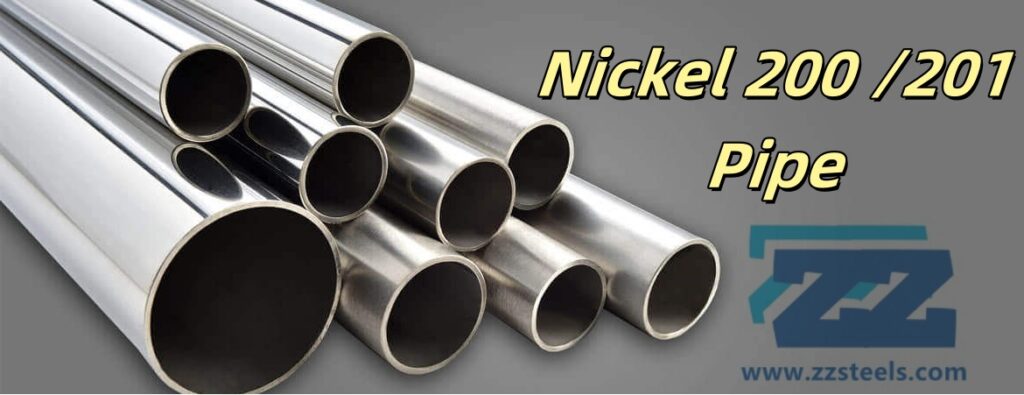
Specification For Nickel Alloy 200 Pipe
| Specifications | ASTM B163, B730 / ASME SB167, SB516 |
| Dimensions | ASTM, ASME and API |
| Size | 1/2″ NB – 24″ NB |
| Wall Thickness | Schedule 5S – Schedule XXS. |
| Manufacturing Shapes | Round, Rectangle, Square, Hex |
| Manufacturing Techniques | Seamless / Welded / ERW / Fabricated |
| Schedule Thickness Range | SCH 5, SCH10, SCH 40, SCH 80, SCH 80S, SCH 160, SCH XXS, SCH XS |
| End Types | Plain End, Beveled End, Treaded One End, TBE (Treaded Both Ends) |
| Value Added Services | Cutting, Beveling, Polishing, Threading, Destructive, Non Destructive, Ultrasonic Testing |
| Packing of Tubes | Packed in Wooden Boxes, Plastic Bags, Steel Strips Bundled, or as per Customers Requests |
Applicable Standards
ASTM B161 / ASME SB161: Standard Specification for Seamless Nickel and Nickel Alloy Pipe and Tube.
ASTM B163 / ASME SB163: Standard Specification for Seamless Nickel and Nickel Alloy Condenser and Heat-Exchanger Tubes.
ASTM B725 / ASME SB725: Standard Specification for Welded Nickel and Nickel-Copper Alloy Pipe.
ASTM B730 / ASME SB730: Standard Specification for Welded Nickel and Nickel Alloy Condenser and Heat-Exchanger Tubes.
Chemical Composition of Nickel Alloy 200 High Temperature Pipe
| Grade | C | Mn | Si | S | Cu | Fe | Ni |
| Nickel 200 | 0.15 max | 0.35 max | 0.35 max | 0.01 max | 0.25 max | 0.40 max | 99.0 min |
| Nickel 201 | 0.02 max | 0.35 max | 0.35 max | 0.01 max | 0.25 max | 0.40 max | 99.0 min |
Mechanical Properties of 201 Nickel Alloy Pipe
| Element | Density | Melting Point | Tensile Strength | Yield Strength (0.2%Offset) | Elongation |
| Nickel 200 | 8.9 g/cm3 | 1446 °C (2635 °F) | Psi – 67000 , MPa – 462 | Psi – 21500 , MPa – 148 | 45% |
| Nickel 201 | 8.9 g/cm3 | 1446 °C (2635 °F) | Psi – 67000 , MPa – 462 | Psi – 21500 , MPa – 148 | 45% |
200/201 Nickel Alloy Pipes Equivalent Grades
| STANDARD | WERKSTOFF NR. | UNS | JIS | BS | GOST | AFNOR | EN |
| Nickel 200 | 2.4066 | N02200 | NW 2200 | NA 11 | НП-2 | N-100M | Ni 99.2 |
| Nickel 201 | 2.4068 | N02201 | NW 2201 | NA 12 | НП-2 | – | LC-Ni 99 |
ASTM B161 Nickel Alloy Pipe Pressure Rating
| Tube O.D. | Wall Thickness of Tube (inches) | |||||||
| (in.) | 0.028 | 0.035 | 0.049 | 0.065 | 0.083 | 0.095 | 0.109 | 0.12 |
| Working Pressure (psig) | ||||||||
| 1/8 | 7900 | 10100 | ||||||
| 1/4 | 3700 | 4800 | 7000 | 9500 | ||||
| 5/16 | 3700 | 5400 | 7300 | |||||
| 3/8 | 3100 | 4400 | 6100 | |||||
| 1/2 | 2300 | 3200 | 4400 | |||||
| 3/4 | 2200 | 3000 | 4000 | 4600 | ||||
| 1 | 2200 | 2900 | 3400 | 3900 | 4300 | |||
Permissible Variations for Small Diameter and Light Wall Tube
| Length,ft | Tube Size,in. | Permissible Variations,in. Under |
||||
| Over | Under | |||||
| U.S.Customary Units | ||||||
| Under 1 | Up to 1.250, incl | 1/32 | 0 | |||
| 1 to 4, incl | Up to 1.250, incl | 1/16 | 0 | |||
| Over 4 to 10, incl | Up to 1.250, incl | 3/32 | 0 | |||
| Over 10 | Up to 1.250, incl | 3/16 | 0 | |||
| Metric Units | ||||||
| Length, m | Tube Size,mm | Over | Permissible Variations,mm Under |
|||
| Under 0.3 | Up to 31.75, incl | 0.794 | 0 | |||
| 0.3 to 1.2, incl | Up to 31.75, incl | 1.59 | 0 | |||
| 1.2 to 3.0, incl | Up to 31.75, incl | 2.38 | 0 | |||
| Over 3.0 | Up to 31.75, incl | 4.76 | 0 | |||
| Specified Outside Diameter,in. | Outside Diameter,in | Inside Diameter,in | Wall Thickness,% | |||
| + | – | + | – | + | – | |
| U.S.Customary Units | ||||||
| Under 3/32 | 0.002 | 0 | 0 | 0.002 | 10 | 10 |
| to 3/16 (0.1875), excl | 0.003 | 0 | 0 | 0.003 | 10 | 10 |
| 3/16 to 1/2 (0.500), excl | 0.004 | 0 | 0 | 0.004 | 10 | 10 |
| 1/2 to 11/4 (1.250), incl | 0.005 | 0 | 0 | 0.005 | 10 | 10 |
| Millimetres | ||||||
| Under 2.38 | 0.051 | 0 | 0 | 0.051 | 10 | 10 |
| 2.38 to 4.76, excl | 0.076 | 0 | 0 | 0.076 | 10 | 10 |
| 4.76 to 12.70, excl | 0.102 | 0 | 0 | 0.102 | 10 | 10 |
| 12.70 to 31.8, incl | 0.127 | 0 | 0 | 0.127 | 10 | 10 |
Nickel 200/201 Pipe Benefits
High resistance to various reducing chemicals
Excellent corrosion resistance
High electrical conductivity
Excellent corrosion resistance to distilled water and natural water
Resistance to neutral and alkaline salt solutions
Excellent resistance to dry fluorine
Widely used in the processing of caustic soda
Good thermal, electrical, and magnetic properties
Some resistance to hydrochloric acid and sulfuric acid at moderate temperatures and concentrations
You can get an offer for products in below material forms:
-Pipe and Tube (EN 10216-5, ASTM A213, ASTM A249, A312, A790,)
-Forged Fitting and Flange (ASTM A182 , ASTM A105,ASTM B564 )
-Butt Weld Fittings (ASTM A234, ASTM A403,ASTM A815)
-Round bar , Billet (ASTM A276, ASTM A479)
– Plate, Sheet, Strip(ASTM A240, EN 10028-7, A480)
-Bolting, Nuts(ASTM A193, A194, A320)
How to Select the Appropriate Nickel 200/201 Pipe
Temperature Considerations: If the operating temperature is below 315°C, Nickel 200 typically meets the requirements; however, when temperatures exceed 600°F (approximately 315°C), Nickel 201, due to its low-carbon properties, offers better resistance to graphitization and embrittlement, making it the more suitable choice.
Medium Corrosivity: Select based on the specific composition and corrosivity of the medium. For strong reducing acids such as hydrochloric acid and sulfuric acid, both types of tubing have some resistance, but further determination is required based on concentration and temperature.
Strength Requirements: If the application requires high ultimate tensile strength, Nickel 200 may be more suitable due to its relatively higher ultimate tensile strength.
Toughness requirements: Both Nickel 200 and 201 pipes exhibit good toughness. However, in industrial applications in extremely cold regions, their toughness performance at low temperatures must be further evaluated to ensure the tubes do not undergo brittle fracture in low-temperature environments.
As nickel-based alloy tubes, Nickel 200/201 pipes have relatively high costs. When selecting them, factors such as the service life of the tubes, maintenance costs, and their impact on the production process should be comprehensively considered. If you have any questions, please feel free to contact us.
Conclusion
Nickel 200/201 pipe, with its unique chemical composition, exceptional corrosion resistance, excellent mechanical properties, and wide operating temperature range, plays an indispensable role in numerous industries such as chemical, electronics, food processing, aerospace, petrochemical, and marine/offshore engineering. Its long service life, high reliability, broad applicability, and excellent machining and welding properties make it an outstanding choice in the industrial tubing sector. When selecting Nickel 200/201 pipe, it is essential to consider factors such as the application environment, mechanical performance requirements, and cost to ensure the selection of the most suitable tubing for specific engineering needs. As industrial technology continues to advance, Nickel 200/201 pipe is expected to find applications in more fields and continue to drive progress and development across various industries.