
In modern industry, steel pipes serve as a vital construction and manufacturing material, widely applied across various fields. Whether in pipeline systems for fluid transportation or in mechanical components and engineering structures, steel pipes play a crucial role. Based on production processes, steel pipes are primarily categorized into two types: seamless steel pipes and welded steel pipes.
If you are looking for suppliers of seamless and welded pipes, please contact us
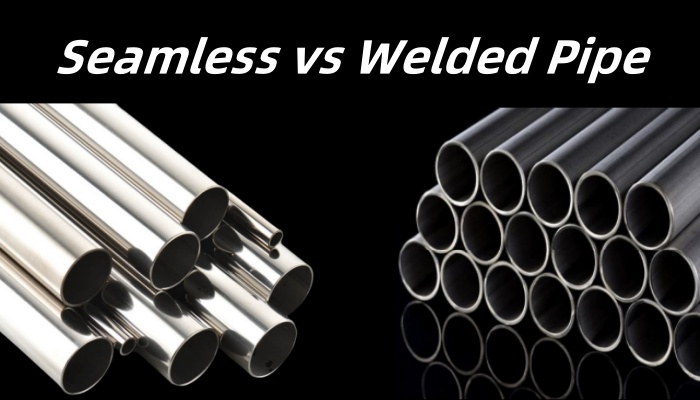
What Are Steel Pipes?
Steel pipes are hollow, elongated steel products primarily used for conveying fluids (such as petroleum, natural gas, water, gas, steam, etc.) and also for manufacturing mechanical components and engineering structures. Due to their lightweight yet high-strength properties, they have replaced traditional solid steel in many applications, becoming the material of choice. Additionally, steel pipes are commonly used in the production of various conventional weapons, such as gun barrels and artillery shells.
Manufacturing Process
Seamless Steel Pipe:
Produced by piercing a solid tube blank or steel ingot, followed by hot rolling, cold rolling, or cold drawing. Throughout this process, no weld seam forms inside the pipe, hence the name “seamless.”
Hot Rolling: A solid round billet is heated and pierced, then rolled and elongated through a series of rolling mills until the desired dimensions and wall thickness are achieved.
Cold Drawing / Cold Rolling: Based on the hot-rolled pipe, cold drawing or cold rolling is used to further reduce the diameter and wall thickness while improving dimensional accuracy and surface finish.
Welded Pipe:
Welded pipes are typically made from stainless steel plates or strips that are cold-formed into a cylindrical shape and then welded. The main welding methods include:
TIG Welding: Uses a tungsten electrode and an inert gas shield to weld the edges of the plate. It produces high-quality welds and is often used for pipes with strict quality requirements.
Laser Welding: Uses a high-energy-density laser beam for welding. It offers fast welding speed and a small heat-affected zone.
Plasma Welding: Falls between TIG and laser welding in terms of energy density. It is suitable for thicker materials.
Resistance Welding (ERW – Electric Resistance Welding): Heats the edges using electrical current until they fuse together. It is highly efficient but may produce welds of lower quality compared to TIG welding.
Characteristics of Seamless Steel Pipes
1. High Pressure Resistance: With no welded seams, seamless steel pipes feature a more uniform overall structure, granting them superior pressure resistance. They are suitable for use in harsh environments involving high pressure and high temperatures.
2. High Precision: Seamless steel pipes feature smooth inner and outer walls with high dimensional accuracy, making them suitable for applications demanding low fluid resistance and precise flow control.
3. Excellent Corrosion Resistance: Seamless steel pipes can utilize specialized materials and surface treatment technologies to enhance corrosion resistance and extend service life.
Characteristics of Welded Pipes
1. High Production Efficiency: The relatively simple production process of welded pipes enables continuous and automated manufacturing, significantly boosting production efficiency.
2. Lower Cost: Due to their straightforward production method and high material utilization, welded pipes offer relatively low costs, making them suitable for high-volume, low-cost applications.
3. Diverse Specifications: Welded pipes can be produced in various diameters, wall thicknesses, and lengths to meet diverse engineering requirements.
Structural Strength
Due to differences in manufacturing processes, the structural strength and risk resistance of the two materials are fundamentally distinct, serving as the core basis for selection in industrial applications.
Seamless Steel Pipe:
Lacking welded seams, seamless steel pipes feature a continuous and complete metallic structure. When subjected to pressure, impact, or high temperatures, stress is evenly distributed across the entire pipe wall. This prevents localized fractures caused by material variations at welds or welding defects such as incomplete fusion or porosity.
Welded pipes
The strength of welded pipes is directly influenced by weld quality: if welding processes meet standards, weld strength can approach that of the base material. However, if processes are substandard, defects like slag inclusions or cracks may form at the weld, creating “structural weaknesses.” Under high pressure, low temperatures, or frequent vibration, these welds are more prone to failure.
Application Areas
Seamless Steel Pipes:
High-Pressure and Critical Applications: The preferred choice for high-pressure, high-temperature, and high-strength environments such as oil and gas transmission, high-pressure boilers, chemical equipment, hydraulic systems, and nuclear power plants. In these applications, safety is paramount, and seamless tubes offer unmatched reliability.
Applications Demanding Consistency: Precision machinery structures, aerospace, and other scenarios with stringent requirements for pipe strength and reliability.
Welded Pipes:
Low-Pressure and General-Purpose Applications: Widely used for conveying low-pressure fluids like water, gas, and air. Their cost advantage and flexible sizing make them ideal for construction, structural engineering, furniture manufacturing, sports equipment, and similar fields.
Large-Diameter Projects: Long-distance oil and gas pipelines (especially spiral welded pipes), urban water supply and drainage networks, and other projects requiring large diameters and extended lengths.
Performance Characteristics
Seamless steel pipes, lacking welded seams, generally exhibit superior pressure-bearing capacity and are suitable for demanding environments such as high-pressure and high-temperature applications. Additionally, seamless steel pipes offer relatively higher precision and surface smoothness, making them ideal for scenarios with stringent performance requirements.
Welded pipes: Although their pressure-bearing capacity is slightly lower than seamless steel pipes, they are more cost-effective and offer greater convenience in processing and installation.
Surface Quality
Seamless steel pipes undergo high-temperature hot rolling, forming a layer of iron oxide scale on the surface that affects smoothness. For high-precision surfaces, additional post-processing such as cold drawing and polishing is required.
The raw material steel strip for welded pipes has a smooth surface. After forming, the weld seam undergoes treatment, resulting in inner and outer surfaces that are typically flatter and smoother than seamless pipes.
Corrosion Resistance
Seamless steel pipes possess superior corrosion resistance due to their monolithic structure, which eliminates potential hazards like intergranular corrosion in weld zones caused by heat-affected zones.
The weld zones of welded pipes undergo microstructural changes during high-temperature welding, making them more susceptible to corrosion initiation. In certain specialized media or environments, welds may corrode earlier than the base material.
How to Choose Between Seamless and Welded Pipes
1. Consider the operating environment: First, select the appropriate pipe material based on the project’s environmental conditions and usage requirements. For instance, in high-temperature, high-pressure, or corrosive environments, seamless steel pipes should be prioritized; whereas in general construction or low-pressure transportation applications, welded pipes offer an economical and practical choice.
2. Pay Attention to Pipe Specifications: Select appropriate pipe specifications based on project requirements. Both welded and seamless pipes offer multiple specifications, including diameter, wall thickness, and length.
3. Focus on Material Quality: When selecting pipes, pay attention to material indicators such as chemical composition, mechanical properties, and corrosion resistance to ensure compliance with relevant standards and specifications.
4. Consider Cost Factors: While meeting project requirements, cost considerations are also important. Generally, welded pipes have lower production costs and are relatively inexpensive, whereas seamless steel pipes involve more complex manufacturing processes and thus carry higher costs.