
ASME B16.11 socket weld tee is a high-pressure pipe connection component forged from round steel or ingots and then lathe-machined. It is used to achieve a “one pipe, two branches” configuration in piping systems. Its core structure consists of three ports: a main pipe port and two branch pipe ports, all connected using socket welding. Unlike conventional threaded or butt-weld tees, a socket weld tee features a “socket-and-spigot” design. The pipe can be directly inserted into the socket and then secured by welding, creating a tight, sealed connection. Socket weld tees are primarily used in high-pressure, precision applications such as the petrochemical, power generation, aerospace, and defense industries. Its manufacturing process involves hot pressing, radial compression, and branch pipe stretching, unlike the metal compensation method used in hydroforming.
Forged socket weld tees are categorized by construction as either equal or reduced. Sizes range from DN6 to DN100, with DN15 to DN50 being the most common. Materials include carbon steel, stainless steel, and alloy steel. Pressure ratings include 3000 lbf, 6000 lbf, and SCH80. The product complies with the American standard ASME B16.11.

Socket Weld Tee Specification
| Standard | ASME 16.11, MSS SP-79, MSS SP-95, 83, 95, 97, BS 3799 |
| Size : | 1/8″ NB TO 4″ NB(DN6 – DN100) |
| Class : | 3000LBS, 6000LBS, 9000LBS |
| Type : | Socket Weld Fitting Tee, Socket Weld Equal Tee, Socket Weld Unequal Tee |
ASMJE B16.11 Socket Weld Tee Types & Weight Chart
Equal Socket Weld Tee
An equal-diameter socket weld tee has three identical pipe openings and is commonly used in piping systems with identical main and branch pipe sizes. It ensures even flow distribution or confluence between the main and branch pipes, maintaining flow stability and pressure balance. Equal-diameter tees are widely used in applications requiring high fluid transport requirements, such as the oil and gas, chemical, and power industries.
Reducing Socket Weld Tee
A reducing socket weld tee has branch pipes with smaller diameters than the main pipe and is used to connect main and branch pipes of different sizes. It allows for a transition in pipe diameter when branching, effectively adjusting flow and pressure, and optimizing the efficiency of the piping system. Reducing tees are often used in applications requiring variable flow rates or flow split ratios, and are particularly common in high-pressure, high-temperature, and corrosion-resistant pipeline projects.
Application Areas
Oil and Gas Transportation
Chemical and Petrochemical Plants
Power and Boiler Systems
Shipbuilding and Marine Engineering
High-Pressure Hydraulic and Steam Systems
Forged Tee Weight Chart in KG
| DN | NPS | 3000 | 6000 | 9000 |
| 6 | 1/8 | 0.13 | 0.22 | – |
| 8 | 1/4 | 0.14 | 0.25 | – |
| 10 | 3/8 | 0.16 | 0.45 | – |
| 15 | 1/2 | 0.35 | 0.55 | 1.15 |
| 20 | 3/4 | 0.48 | 0.90 | 1.80 |
| 25 | 1 | 0.66 | 1.46 | 2.25 |
| 32 | 1-1/4 | 1.00 | 1.90 | 3.95 |
| 40 | 1-1//2 | 1.40 | 2.80 | 4.87 |
| 50 | 2 | 2.00 | 3.70 | 8.89 |
| 65 | 2-1/2 | 4.10 | – | – |
| 80 | 3 | 5.55 | – | – |
| 100 | 4 | 15.6 | – | – |
ASME B16.11 Socket Weld Tee Dimensions
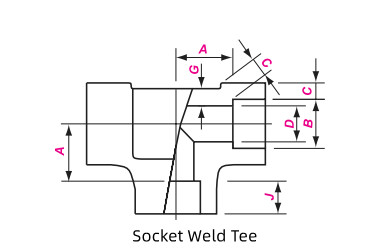
| DN | NPS | B | C | A | G | |||||||||
| 3000 | 6000 | 9000 | 3000 | 6000 | 9000 | 3000 | 6000 | 9000 | ||||||
| 6 | 1/8 | 10.9 | 3.18 | 3.18 | 3.96 | 3.43 | – | – | 11.0 | 11.0 | – | 2.41 | 3.15 | – |
| 8 | 1/4 | 14.3 | 3.78 | 3.30 | 4.60 | 4.01 | – | – | 11.0 | 13.5 | – | 3.02 | 3.68 | – |
| 10 | 3/8 | 17.7 | 4.01 | 3.5 | 5.03 | 4.37 | – | – | 13.5 | 15.5 | – | 3.20 | 4.01 | – |
| 15 | 1/2 | 21.9 | 4.67 | 4.09 | 5.97 | 5.18 | 9.53 | 8.18 | 15.5 | 19 | 25.5 | 3.73 | 4.78 | 7.47 |
| 20 | 3/4 | 27.3 | 4.09 | 4.27 | 6.96 | 6.04 | 9.78 | 8.56 | 19 | 25.5 | 28.5 | 3.91 | 5.56 | 7.82 |
| 25 | 1 | 34.0 | 5.69 | 4.98 | 7.92 | 6.93 | 11.38 | 9.96 | 22.5 | 27.0 | 32.0 | 4.55 | 6.35 | 9.09 |
| 32 | 11/4 | 42.8 | 6.07 | 5.28 | 7.92 | 6.93 | 12.14 | 10.62 | 27.0 | 32.0 | 35.0 | 4.85 | 6.35 | 9.70 |
| 40 | 11/2 | 48.9 | 6.35 | 5.54 | 8.92 | 7.80 | 12.7 | 11.12 | 32.0 | 38.0 | 38.0 | 5.08 | 7.14 | 10.15 |
| 50 | 2 | 61.2 | 6.93 | 6.04 | 10.92 | 9.50 | 13.84 | 12.12 | 38.0 | 41.0 | 54.0 | 5.54 | 8.74 | 11.07 |
| 65 | 21/2 | 73.9 | 8.76 | 7.62 | – | – | – | – | 41.0 | – | – | 7.01 | – | – |
| 80 | 3 | 89.9 | 9.52 | 8.30 | – | – | – | – | 57.0 | – | – | 7.62 | – | – |
| 100 | 4 | 115.5 | 10.69 | 9.35 | – | – | – | – | 66.5 | – | – | 8.56 | – | – |
2) Considering the tolerance of outside diameter of pipe, the diameters of some socket bore can be a little larger than the ones specified in B16.11.
3) When the sizes of the connecting pipes are not conformed to the ones specified in this catalog, the sizes of the connecting pipes shall be provided in the purchase specification.
4) When the fittings are reducing,the structure sizes shall be same as the ones of the straight fittings and B J D shall be machined per the according reducing ends.
5) Fittings can also be manufactured as the mixed connectings of Socket Weld and Threaded.
Material & Grades of Forged Fittings Tees
Carbon Steel :
ASTM A105 / A105N,ASTM A350 LF2 / LF3, A694 F42 / 46 / 52 / 56 / 65 / 70
Alloy Steel :
ASTM / ASME A/SA 182 & A 387 F1, F5, F9, F11, F12, F22, F91
Stainless Steel :
ASTM A 182, A 240 F 304, 304L, 304H, 316, 316L, 316Ti, 310, 310S, 321, 321H, 317, 347, 347H, 904L
Duplex & Super Duplex Steel :
ASTM / ASME A/SA 182 F 44, F 45, F51, F 53, F 55, F 60, F 61
Copper Alloy Steel :
ASTM SB 61 , SB62 , SB151 , SB152 UNS No. C 70600 (Cu-Ni 90/10), C 71500 (Cu-Ni 70/30), UNS No. C 10100, 10200, 10300, 10800, 12000, 12200
Nickel Alloy :
ASTM SB564, SB160, SB472, SB162 Nickel 200 (UNS No. N02200), Nickel 201 (UNS No. N02201), Monel 400 (UNS No. N04400), Monel 500 (UNS No. N05500), Inconel 800 (UNS No. N08800), Inconel 825 (UNS No. N08825), Inconel 600 (UNS No. N06600), Inconel 625 (UNS No. N06625), Inconel 601 (UNS No. N06601), Hastelloy C 276 (UNS No.N10276), Alloy 20 (UNS No. N08020)
ASME B16.11 Standard
This Standard covers ratings, dimensions, tolerances,marking, and material requirements for forged fittings, both socket-welding and threaded, as illustrated in Tables 1 through 5 and Tables I-1 through I-5, inclusive.
Fitting Types/Configuration.
Types of fittings covered by this Standard are shown in Table 6, by class and size range.
Special Fittings.
Fittings with special dimensions, threads, or counterbores may be made by agreement between the manufacturer and purchaser.
When such fittings meet all other stipulations of this
Standard, they shall be considered in compliance therewith, provided they are appropriately marked.
Tolerance
Concentricity of Bores
The socket and fitting bores shall be concentric within a tolerance of 0.8 mm (0.03 in.) for all sizes. Opposite socket bores shall be concentric within a tolerance of 1.5 mm (0.06 in.) for all sizes.
Coincidence of Axes
The maximum allowable variation in the alignment of the fitting bore and socket bore axes shall be 1 mm in 200 mm (0.06 in. in 1 ft). The maximum allowable variation in alignment of threads shall be 1 mm in 200 mm (0.06 in. in 1 ft).
| Nominal Size | All Fittings | Tees | Reducer Inserts | ||||
| Socket Bore Dia. |
Bore Dia. of Fittings |
Center to Bottom of Socket |
Laying Length |
Shank Dia. | Length | ||
| DN | NPS | B | D | A H | A | SD | SL |
| 6~8 | 1/8~1/4 | +0.4 0 |
+1.5 0 |
± 1.0 | +1.5 0 |
± 0.25 | 0 -1.5 |
| 10~20 | 3/8~3/4 | +0.4 0 |
+1.5 0 |
± 1.5 | +1.5 0 |
± 0.25 | 0 -1.5 |
| 25~40 | 1~11/2 | +0.4 0 |
+1.5 0 |
± 2.0 | +2.0 0 |
± 0.25 | 0 -2.0 |
| 50 | 2 | +0.5 0 |
+1.5 0 |
± 2.0 | +2.0 0 |
± 0.5 | 0 -2.0 |
| 65~80 | 21/2~3 | +0.5 0 |
+3.0 0 |
± 2.5 | +2.5 0 |
± 0.5 | 0 -2.5 |
| 100 | 4 | +0.5 0 |
+3.0 0 |
± 2.5 | +2.5 0 |
± 0.7 | 0 -2.5 |
Marking and Packaging
Our products, such as our ASME B16.11 socket weld tees, are carefully packaged to prevent damage during shipping. For export, we use standard wooden crates or cartons. All forged socket weld tees are marked with our trademark (company logo), grade, size, and batch number. We can also customize our products with custom labeling upon request.
Manufacturers of ASME B16.11 Forged Fittings
The Socket Weld Tee, with its advantages of high-pressure resistance, corrosion resistance, easy installation, and wide applicability, has become an indispensable key component in industrial piping systems. Selecting the appropriate Socket Weld Tee can significantly enhance the stability and service life of the piping system.
When purchasing Socket Weld Tees, it is recommended to prioritize products manufactured by reputable manufacturers that comply with international/domestic standards, and to select the appropriate type based on the characteristics of the medium and operating conditions. During installation, strict adherence to specifications is essential to ensure the quality of the connections.