
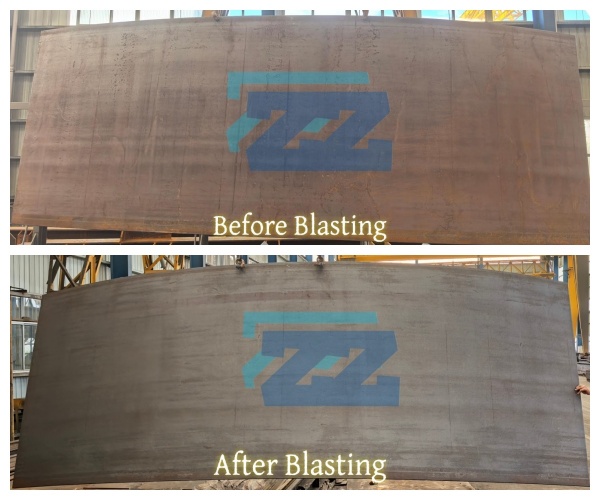
Before Blasting vs After Blasting_zizi Oil Tank Sandblasting
Why Surface Preparation Is Critical for Oil Tank Anti-Corrosion
Many people think anti-corrosion performance depends only on the coating. In reality, surface preparation decides how long the coating lasts.
Anti-corrosion primer bonds to steel through mechanical anchoring and chemical bonding. If rust, mill scale, or oil remains, the primer sits on a layer of “loose soil.” The coating will blister and peel. Oil tank sandblasting removes this layer and creates uniform roughness. The primer then gets a firm grip.
Simply put: surface preparation determines coating adhesion. Coating adhesion determines steel structure service life.
Fiji Environment: A Harsh Test for Storage Tank Coating
The Fiji tank project faces extreme conditions.
High salt fog, high humidity, strong UV, and large temperature swings. ISO 12944 classifies these as high corrosion categories. Steel storage tanks and silos corrode much faster than inland assets. Tank roof plates face constant sun, rain, and salt deposition. They fail first.
Corrosion Categories & Rust Removal Grade Requirements by Environment
|
Environment |
ISO 12944 Category | Corrosion Rate | Rust Removal Grade |
Coating System |
|
Inland dry |
C2 (Low) | Low | Sa2 |
Standard epoxy primer + topcoat |
|
Inland humid/urban |
C3 (Medium) | Medium | Sa2.5 |
Epoxy primer + intermediate + topcoat |
|
Coastal/industrial |
C4 (High) | High | Sa2.5 |
High-build epoxy + intermediate + polyurethane topcoat |
|
Fiji/offshore |
C5 (Very high) | Very high | Sa2.5~Sa3 |
Heavy-duty epoxy + multiple topcoats |
Fiji tank anti-corrosion design requires higher rust removal grades, stable surface roughness, and thicker coating systems. Storage tank anti-corrosion starts at roof plate sandblasting.
What Does Tank Roof Plate Sandblasting Actually Do?
Sandblasting is not just “knocking off rust.” It achieves three core goals at once.
Remove rust and contaminants: Mill scale, rust, oil, and soluble salts must be fully removed. This eliminates hidden corrosion under the coating.
Create uniform surface roughness (anchor profile): Abrasive impact forms microscopic peaks and valleys. This gives the primer reliable mechanical anchoring.
Meet the specified rust removal grade: Tank anti-corrosion usually requires Sa2.5 (near-white). No visible oil, dirt, mill scale, rust, or old coating. Only slight staining is allowed. Verify against ISO 8501-1 photos.
Three Core Goals of Oil Tank Sandblasting
|
Core Goal |
Specific Requirement |
Acceptance Standard |
|
Remove rust & contaminants |
No mill scale, rust, oil, or salt |
ISO 8501-1 |
|
Establish surface roughness |
Uniform microscopic peaks and valleys |
ISO 8503 |
|
Achieve rust removal grade |
Sa2.5 (near-white) |
ISO 8501-1 |
Sandblasting is the method. The goal is to make every coating bond firmly to the steel.
How to Control Key Sandblasting Parameters
Sandblasting quality depends on multiple parameters working together.
|
Parameter |
Recommended Range |
Description |
|
Abrasive selection |
Quartz sand, copper slag, steel shot |
Choose based on corrosion degree and surface condition |
|
Blasting pressure |
0.6~0.8 MPa |
Enough impact energy without damaging the plate |
|
Blasting angle & distance |
Adjust by plate area |
Uniform coverage, no dead corners |
|
Surface roughness |
40~80 μm (Rz) |
Too shallow = poor adhesion. Too deep = primer cannot cover peaks |
Abrasive, Pressure, Angle & Roughness Control
Abrasive selection: Choose quartz sand, copper slag, or steel shot based on steel plate corrosion. Particle size directly affects roughness.
Blasting pressure: Control at 0.6~0.8 MPa. This ensures impact energy without over-damaging the plate.
Blasting angle and distance: Adjust by plate area. Ensure uniform coverage with no dead corners.
Roughness control: Tank steel plate roughness should be 40~80 μm (Rz). Too shallow weakens adhesion. Too deep prevents primer coverage on peaks.
Precise parameter control means the rust removal grade and roughness pass in one pass. No rework.
From Sandblasting to Primer: Cleanliness & Roughness Both Matter
After sandblasting, you cannot wait freely before painting.
Sandblasted steel is highly active. It flash-rusts quickly in humid air. Apply anti-corrosion primer within 8 hours. Before painting, remove dust with compressed air or a vacuum. Meet ISO 8502-3 dust cleanliness requirements.
Painting Window & Cleanliness Requirements After Sandblasting
|
Control Item |
Requirement |
Standard |
|
Painting interval |
Within 8 hours |
Industry practice |
|
Surface dust cleanliness |
Not greater than specified grade |
ISO 8502-3 |
|
Residual oil |
No visible oil or dirt |
ISO 8501-1 |
Tank anti-corrosion typically uses “primer + intermediate + topcoat.” Epoxy primer bonds directly to steel and provides base protection. Only proper surface preparation lets this coating system reach its design life.
Quality Acceptance: How to Verify Surface Preparation
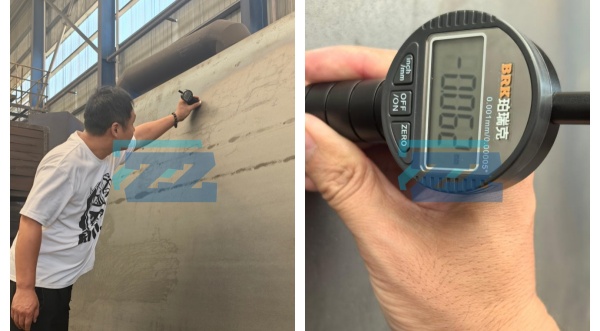
Blasting Quality Inspection
Surface preparation quality needs clear acceptance criteria. Not visual “feel.”
|
Acceptance Item |
Requirement |
Standard |
|
Rust removal grade |
Sa2.5 (near-white) |
ISO 8501-1 |
|
Surface roughness |
40~80 μm (Rz) |
ISO 8503 |
|
Dust cleanliness |
Not greater than specified grade |
ISO 8502-3 |
|
Residual oil |
No visible oil or dirt |
ISO 8501-1 |
Every indicator is documented and traceable. This is the foundation of anti-corrosion engineering quality.
Steel Structure & Silo Processing: Surface Preparation Across Applications
This surface preparation logic covers more than Fiji tanks. It applies to steel storage tanks, silo processing, and many anti-corrosion components.
|
Application |
Components | Rust Removal Grade | Roughness |
Coating System |
|
Fiji tank |
Roof plates, wall plates | Sa2.5 | 40~80 μm |
Heavy-duty epoxy |
|
Steel storage tank |
Tank body, accessories | Sa2.5 | 40~80 μm |
Epoxy primer + topcoat |
|
Silo processing |
Roof plates, walls | Sa2.5 | 40~80 μm |
Epoxy primer + intermediate + topcoat |
|
Steel components |
H-beams, platform railings | Sa2.5 | 40~80 μm |
Epoxy primer + polyurethane topcoat |
Whether tank wall plates, silo roof plates, or H-beams and platform railings — surface preparation depth determines coating lifespan. For manufacturers, guarding the sandblasting gate makes painting, installation, and operation flow smoothly.
Who We Are: Steel Structure, Silo Processing & Anti-Corrosion Contractor
We specialize in metal surface treatment and anti-corrosion coating. We have years of experience in Fiji tank, large storage tank, silo, and complex steel structure projects.
From sandblasting to primer, from parameter control to quality acceptance — we follow ISO standards. Our service philosophy: professional, honest, efficient. Every process withstands time and environment.
Our Services
Steel storage tank, silo processing, and anti-corrosion coating
On-site sandblasting and coating for large components
Special anti-corrosion solutions for high-corrosion environments (Fiji, chemical, offshore)
Solid surface preparation builds the foundation for long-term anti-corrosion. Quality starts with us.
FAQ: Oil Tank Sandblasting & Rust Removal
Q1: What rust removal grade is required for tank sandblasting?
Tank anti-corrosion usually requires Sa2.5 (near-white). Verify against ISO 8501-1 photos. No visible oil, dirt, mill scale, rust, or old coating.
Q2: What surface roughness is appropriate?
Tank steel plate roughness should be 40~80 μm (Rz). Too shallow affects adhesion. Too deep prevents primer coverage on peaks.
Q3: Sandblasting vs. shot blasting — what is the difference?
|
Item |
Sandblasting |
Shot Blasting |
|
Driving method |
Compressed air drives abrasive |
Centrifugal force throws steel shot |
|
Application |
On-site large components, tank walls |
Factory batch processing of plates and sections |
|
Flexibility |
High, suits complex sites |
Lower, suits regular components |
|
Efficiency |
Medium |
High |
Q4: How soon must primer be applied after sandblasting?
Within 8 hours. Remove surface dust before painting to prevent flash rust and contamination.
Q5: What should be noted for steel tank anti-corrosion in Fiji?
Design for high-corrosion environment (ISO 12944 C5). Increase rust removal grade. Watch salt and moisture impact on the painting window.
Contact us for steel structure processing, silo manufacturing, or anti-corrosion construction. Professional team. Honest cooperation. We protect your project.