
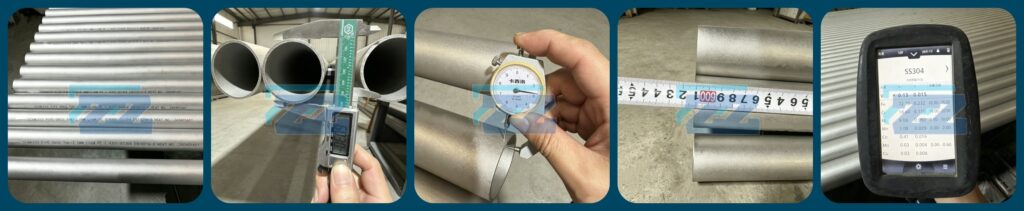
EN10216-5 stainless steel seamless tubes are widely used in pressure vessels, water supply piping systems, and other pressure-bearing industrial tube projects. These European-standard stainless steel tubes and their matching fittings are one of our company’s main product lines.
Recently, we successfully completed and delivered a batch of EN10216-5 stainless steel seamless tubes for a Singapore regular customer. This batch of tubes will be used in a municipal water supply system project in Singapore.
The material is 1.4301 (SS304), designed with a fixed length of 6 meters, and wall thicknesses ranging from 2 to 3 mm, placing them in the category of high-precision, thin-wall seamless steel tubes.
Purchase List
| SN | TYPE | SIZE | WT (mm) | MATERIAL | DETAILES | Qty | Unit |
| 37 | Pipe | DN100 | 3 | 1.4301/SS304 | SEAMLESS,1.4301/SS304,EN 10216-5,PE | 54 | M |
| 38 | Pipe | DN15 | 2 | 1.4301/SS304 | SEAMLESS,1.4301/SS304,EN 10216-5,PE | 30 | M |
| 39 | Pipe | DN100 | 3 | 1.4301/SS304 | SEAMLESS,1.4301/SS304,EN 10216-5,PE | 60 | M |
| 40 | Pipe | DN25 | 2.5 | 1.4301/SS304 | SEAMLESS,1.4301/SS304,EN 10216-5,PE | 198 | M |
| 41 | Pipe | DN40 | 2.5 | 1.4301/SS304 | SEAMLESS,1.4301/SS304,EN 10216-5,PE | 48 | M |
| 42 | Pipe | DN65 | 3 | 1.4301/SS304 | SEAMLESS,1.4301/SS304,EN 10216-5,PE | 24 | M |
| 43 | Pipe | DN80 | 3 | 1.4301/SS304 | SEAMLESS,1.4301/SS304,EN 10216-5,PE | 78 | M |
| 44 | Pipe | DN50 | 2.5 | 1.4301/SS304 | SEAMLESS,1.4301/SS304,EN 10216-5,PE | 240 | M |
| TOTAL | 1440 | EA | |||||
The wall thickness of this order is only 2-3 mm, which qualifies as thin-wall tube. In accordance with standard engineering practice and customer requirements, the tube ends are supplied with a Plain End (PE) finish, without Bevel End (BE) machining. This ensures the flatness of the stainless steel tube ends and avoids the risk of damage that beveling might cause to thin-wall pipes.
PE (Plain End): The pipe end is cut square to the axis with no angled surface. Commonly used for socket-welding, threaded connections, or as preparation for on-site beveling before butt welding.
BE (Beveled End): The pipe end is machined with an angled surface (typically 30°-37.5°) for butt-welding to ensure full weld penetration.
EN10216-5 Stainless Steel Seamless Tubes
In the field of pressure equipment and industrial piping systems, EN10216-5 standard stainless steel seamless tubes are a core material choice in Europe and global markets, thanks to their excellent performance and strict technical specifications. This article provides a comprehensive overview of this European-standard product, covering its standard system, material comparisons, and application scope.
EN10216-5 Standard Scope
EN10216-5 is a standard established by the European Committee for Standardization, forming part of the “Seamless steel tubes for pressure purposes” series, and specifically addresses stainless steel seamless tubes.
This document specifies the technical delivery conditions in two test categories for seamless tubes of a circular cross section made of austenitic (including creep resisting steel) and austenitic-ferritic stainless steel which are intended for pressure and corrosion resisting purposes at room temperature, at low temperatures or at elevated temperatures.
This standard is mandatory within the EU and the European Free Trade Association. It serves as the core technical basis for ensuring the safety of pressure equipment such as boilers, pressure vessels, and piping systems, and its requirements comply with the EU Pressure Equipment Directive (PED 2014/68/EU).
| Technical Requirement Category | Specific Content and Requirements |
| Applicable Materials | Austenitic stainless steels (including creep-resistant steels) and austenitic-ferritic duplex stainless steels. |
| Manufacturing Process | Specifies requirements for steelmaking, tube manufacturing, and delivery condition (e.g., solution treatment), as well as clear rules for surface quality and straightness. |
| Chemical Composition | Strictly defines the limits for ladle analysis and product analysis chemical compositions. |
| Mechanical Properties | Provides detailed requirements for tensile strength, yield strength, and impact toughness (e.g., Charpy V-notch impact test) at room, high, and low temperatures. |
| Corrosion Testing | Includes requirements for intergranular corrosion susceptibility testing for austenitic stainless steels. |
| Dimensions and Tolerances | Specifies requirements for outside diameter, wall thickness, mass per unit length, and permissible deviations. |
| Inspection and Testing | Divided into two test categories, including chemical analysis, tensile tests, hydrostatic tests, non-destructive tests like eddy current and ultrasonic testing, as well as dimensional and visual inspection. |
| Marking and Packaging | Specifies marking methods, transport, and packaging requirements for the tubes. |
Normative References
The following documents are referred to in the text in such a way that some or all of their content constitutes requirements of this document. For dated references, only the edition cited applies. For undated references, the latest edition of the referenced document (including any amendments) applies.
EN 10020:2000, Definition and classification of grades of steel
EN 10021:2006, General technical delivery conditions for steel products
EN 10027-1:2016, Designation systems for steels – Part 1: Steel names
EN 10027-2:2015, Designation systems for steels – Part 2: Numerical system
EN 10028-7:2016, Flat products made of steels for pressure purposes – Part 7: Stainless steels
EN 10088-1:2014, Stainless steels – Part 1: List of stainless steels
EN 10168:2004, Steel products – Inspection documents – List of information and description
EN 10204:2004, Metallic products – Types of inspection documents
EN 10266:2003, Steel tubes, fittings and structural hollow sections – Symbols and definitions of terms for use in product standards
CEN/TR 10261:2018, Iron and steel – European standards for the determination of chemical composition
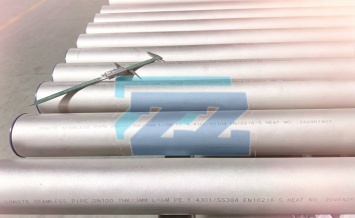
Marking to Be Applied
Depending on the size of the tubes, the following marking shall either be applied on a label attached to the bundle or the box of tubes, or be marked indelibly on each tube at least at one end.
The marking shall include the following information:
manufacturer’s name or trade mark;
dimension of the tubes;
number of this part of EN 10216 and the steel name (or number) (see 5.2);
cast number or a code number;
test category;
mark of the inspection representative;
identification number (e.g. order or item number) which permits the correlation of the product or delivery unit to the related document;
and at the discretion of the manufacturer:
symbol identifying the delivery condition (see Table 1).
Example of marking:
A Note on Product Naming: Seamless Pipe vs. Seamless Tube
In our daily operations, we pay close attention to a practical detail regarding product identification. While customers often specify the product name as “Seamless Pipe” in their purchase orders, the formal designation under the EN 10216-5 standard is “Seamless Tube”.
This difference is not a matter of quality or performance, but rather a reflection of industry terminology across different application contexts. “Pipe” tends to emphasize the engineering function of conveying fluids within piping systems, while “Tube” highlights the precision of cross-sectional dimensions and standardized manufacturing attributes.
As a professional stainless steel tube supplier, we remain firmly customer-oriented. Based on a thorough understanding of both standard requirements and customer preferences, we adopt a flexible marking approach: we strictly follow the customer’s specified marking on the product, while ensuring that every tube we deliver fully complies with all technical specifications and quality requirements of EN 10216-5.
This means that regardless of the marking choice, every single tube we deliver delivers the same excellent quality, rigorous traceability, and comprehensive EN 10204 inspection documentation. We bridge the subtle gap between standard language and customer language in a professional manner, providing our clients with a truly reliable and hassle-free delivery experience.
Material Comparison: The Relationship Between 1.4301 and SS304
1.4301 and SS304 are essentially the same material, named differently due to different standard systems. Understanding this is key to understanding the relationship between European and American standard materials.
1.4301: The numeric designation in European Standards (EN). Its corresponding steel grade is X5CrNi18-10, which is an austenitic stainless steel.
Chemical Composition
| CHEMICAL | LIMITS | C | Mn | P | S | Si | Ni | Cr |
| X5CrNi18-10(1.4301) | MIN | 8.00 | 17.00 | |||||
| MAX | 0.070 | 2.00 | 0.040 | 0.015 | 1.00 | 10.50 | 19.50 |
Mechanical Properties
| Steel grade | Hardness | Tensile properties at room temperature | Impact properties | |||||||
| Steel name | Steel number |
HB max. | Proof Strength | Tensile strength | Elongation | |||||
| Rp0.2 MPa min. |
Rp1.0MPa min. |
Rm MPa | A % min. |
Minimum average absorbed energy | ||||||
| KV J min. | ||||||||||
| at RT | at -196℃ |
|||||||||
| l | t | l | t | t | ||||||
| X5CrNi18-10 | 1.4301 | 215 | 195 | 230 | 500 to 750 | 40 | 35 | 100 | 60 | 60 |
SS304: The common designation in ASTM standards (UNS S30400) from the United States. It is one of the most widely used stainless steels globally.
Chemical Composition
| CHEMICAL | LIMITS | C | Mn | P | S | Si | Ni | Cr |
| ASTM A312 TP304 | MIN | 8.00 | 18.00 | |||||
| MAX | 0.080 | 2.00 | 0.045 | 0.030 | 1.00 | 11.00 | 20.00 |
Mechanical Properties
| MATERIAL | T.S (MPa) | Y.S (MPa) | EL % |
| ASTM A312 TP304 | 515 min | 205 min | 35 min |
Correspondence: The chemical compositions of the two are essentially identical – chromium content 18%-20%, nickel content 8%-10.5%, the classic “18/8” stainless steel. The corresponding grade in the Japanese JIS standard is SUS304, and in the Chinese GB standard, it is 06Cr19Ni10 (formerly 0Cr18Ni9).
Key Characteristics: 1.4301/SS304 offers good corrosion resistance, excellent formability, and weldability, maintaining stable mechanical properties over a wide temperature range from -250°C to 550°C. It is important to note that this material is sensitive to chloride ions. In coastal environments or applications with high chloride exposure, upgrading to molybdenum-containing grades like 1.4401/316 or 1.4404/316L should be considered.
Application Scope of EN10216-5 Stainless Steel Seamless Pipes
As a specialized material for pressure equipment, EN10216-5 stainless steel seamless tubes arewidely used in the following industrial sectors:
| Industry Sector | Typical Applications |
| Oil & Gas | Oil and gas extraction, transmission pipelines, offshore platform equipment. |
| Chemical& Petrochemical | Reactors, heat exchangers, piping systems for corrosive media. |
| Energy & Power | Nuclear power plant components, boiler superheaters, steam lines. |
| Food & Pharmaceutical | Hygienic piping for conveying food, pharmaceuticals, and pure media. |
| Marine Engineering | Seawater desalination plants, marine fittings (molybdenum-containing grades required). |
| Municipal Water Supply | Water treatment systems, service water pipelines. |
The EN10216-5 standard represents a high level of technical achievement for stainless steel seamless tubes used in European pressure equipment. As a core grade within this standard system, 1.4301 (SS304) plays an irreplaceable role worldwide across industries like petrochemicals, energy, food and pharmaceuticals, and municipal engineering due to its excellent comprehensive performance.
For thin-wall pipe applications requiring a balance of pressure resistance, corrosion resistance, and precision dimensions, this European-standard product offers a reliable technical solution.