
SS316L butt weld fittings to EN 10253-4 appear in most EU industrial drawings and PED-certified projects. EN 10253-4 is a complete European technical specification. It covers material, dimensions, pressure design and testing. SS316L is a low-carbon austenitic stainless steel. Checking only drawing dimensions and quantities before ordering often leads to dimensional mismatch at delivery or field welding. This guide is based on a delivered order of EN 10253-4 SS316L butt weld elbows and tees. It explains the purchasing and inspection requirements and how to avoid common risks.
Contact Us:Need compliant EN 10253-4 SS316L butt weld fittings? Send your item list and wall thickness data for a same-day quotation.
SS316L vs EN 1.4404: Material Equivalence and Standard Differences
SS316L maps to the European numeric grade 1.4404. The chemical composition is highly consistent. Carbon is capped at 0.030%. Molybdenum stays between 2.0% and 2.5%. This ultra-low-carbon, molybdenum-bearing design gives strong resistance to chloride pitting. It also prevents intergranular corrosion after welding. In purchasing practice, treat the two designations as equivalent corrosion-resistant grades.
EN 10253-4 vs ASTM A403: A Different System
The US system normally pairs ASTM A403 (material specification) with ASME B16.9 (dimensional specification). EN 10253-4 is a single complete technical specification. It integrates material, dimensions, pressure design and inspection requirements. It is a pressure fitting standard with defined inspection duties. Fittings delivered to this standard must include an EN 10204 3.1 certificate.
- SS316L = EN 1.4404: C ≤ 0.030%, Mo 2.0–2.5%.
- EN 10253-4 is a full technical specification, not a material spec alone.
- EN 10204 3.1 certificate is mandatory for EN deliveries.
- Do not substitute ASTM A403 fittings in EN projects.
Type A Fitting Design: Pressure Derating Logic
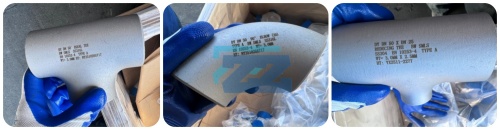
All elbows and tees in this order are marked Type A. This marking directly affects pipeline pressure margin calculation.
Type A vs Type B: Engineering Fit
EN 10253-4 defines two design types.
- Type A: wall thickness matches the straight pipe, but internal pressure capacity is usually lower than the straight pipe (derating factor < 1).
- Type B: body wall thickness is increased to compensate for stress concentration from geometry. Pressure capacity matches the straight pipe.
This order uses 3D bend radius elbows with Type A design. It is an economical choice that balances flow resistance and cost. Key risk: past projects have shown Type A wall thickness data on drawings that was even thinner than the straight pipe. Before production, confirm the derating factor with the designer in writing. Never apply existing tooling without verification.
Order Breakdown and Reducing Tee Wall Thickness Control
This delivered order covers DN15 to DN80 45°/90° elbows and equal/reducing tees. Wall thickness matching and local forming control were the key quality points.

Millimeter Wall Thickness Matching to EN Pipes
The item list shows different wall thickness (WT) configurations under the same nominal diameter. For example, DN 40 45° elbows include both 2.5 mm and 3.6 mm versions. Unlike the US Schedule system, EN uses direct millimeter marking. Each fitting must match the EN 10216-5 stainless steel pipe used on site, one to one.
Table 1: Core order data
|
Fitting type |
Size range (DN) | Wall thickness strategy (WT) | Design type |
Material and standard |
|
45° elbow (3D) |
DN15–DN80 | 2.11 mm–3.0 mm | Type A |
SS316L / EN 10253-4 |
|
90° elbow (3D) |
DN15–DN40 | 2.6 mm–3.6 mm | Type A |
SS316L / EN 10253-4 |
|
Equal tee |
DN40–DN80 | 3.0 mm–3.6 mm | Type A |
SS316L / EN 10253-4 |
|
Reducing tee |
DN40×15–DN80×50 | Run 3.0–3.6 mm / branch 2.5 mm | Type A |
SS316L / EN 10253-4 |
Forming and Wall Thickness Control for Reducing Tees
The main manufacturing difficulty was the reducing tees, such as SN 87: DN40×DN15, run 3.6 mm with branch 2.6 mm. In cold extrusion forming of reducing fittings, the shoulder area where branch meets run is prone to excessive wall thinning. The production team adjusted forming die parameters and applied strict control during solution heat treatment. Final minimum wall thickness fully met the standard. Third-party PT (penetrant testing) reports were all accepted.
Pressure Compliance and End Bevel Requirements
Compared with Part 3, which has no specific inspection requirements, the core value of EN 10253-4 is compliance. Positive material identification (PMI) and non-destructive testing before dispatch protect structural integrity. In actual delivery, end bevel details most often cause field welding problems.
EN 10253 Bevel Rules by Wall Thickness
EN 10253 sets clear wall thickness limits for end bevelling.
- Thin wall (T < 3.2 mm): the manufacturer may choose a square cut, meaning no bevel. Thin-wall items at 2.11 mm or 2.5 mm may arrive with plain cut ends.
- Standard wall (3.2 ≤ T ≤ 20.0 mm): ends must be bevelled at 30° (lower deviation 0). Root face must be held within 1.6 ± 0.8 mm. Too thin a root face burns through. Too thick a root face fails to penetrate.
- Heavy wall (T > 20 mm): bevel type must be agreed between buyer and supplier.
- Internal taper limit: if end machining reduces wall thickness, internal taper must not exceed 18° and external taper must not exceed 30°. No harmful burrs are allowed.
EN vs ASME: Key Dimension Comparison
Dimension and specification differences matter in cross-standard sourcing.
Table 2: EN vs ASME key dimensions and standards
|
Comparison item |
EN system (EN 10253-4 / EN ISO 1127) | US system (ASTM A403 / ASME B16.9) |
Purchasing impact |
|
Wall thickness marking |
Actual wall thickness in mm (e.g. 3.6 mm) | Schedule number (e.g. Sch 10S, 40S) | Verify actual site pipe WT. Never match by diameter alone. |
| Weld bevel | Usually 30° (root face 1.6±0.8 mm) | Usually 37.5° |
Mixing causes field weld failure. Re-machining is required. |
|
Outside diameter tolerance |
EN ISO 1127 (e.g. DN25 = 33.7 mm) | ASME B36.19M (e.g. NPS 1 = 33.4 mm) | Minor misalignment risk when connecting to US valves. Verify actual OD. |
| Inspection and certification | EN 10204 3.1 certificate mandatory | MTR (material test report) usually sufficient | EU PED projects cannot pass compliance review without a 3.1 certificate. |
FAQ: EN 10253-4 SS316L Butt Weld Fittings
Q1: Can EN 10253-4 fittings replace ASTM A403 fittings in a US project?
A: No direct substitution. The material (e.g. 316L) is equivalent, but outside diameter tolerance, wall thickness marking system and bevel angle (30° vs 37.5°) are completely different. Mixing causes field welding failure and does not meet US project compliance requirements.
Q2: How do I choose between Type A and Type B?
A: It depends on system pressure margin. Type A matches straight pipe wall thickness, costs less, and suits designs with pressure margin. Type B increases fitting wall thickness and matches straight pipe pressure capacity. It suits high-pressure or zero-margin lines. If the drawing specifies Type A, do not substitute Type B without approval. It affects overall pipeline stress distribution.
Q3: Why does the same DN40 elbow come in 2.5 mm and 3.6 mm wall thickness?
A: This is normal in the EN system. Millimeter wall thickness marking precisely matches different EN ISO 1127 stainless steel straight pipes on site. Different line wall thickness requires different fitting wall thickness. Always confirm actual straight pipe WT with the site before purchasing.
Q4: What should I check on end bevels when inspecting EN 10253-4 fittings?
A: First, check whether wall thickness is below 3.2 mm. If so, square-cut delivery is possible. Second, for standard wall thickness, sample-check that the bevel angle is 30°. Use a vernier caliper to measure root face thickness within 1.6±0.8 mm. Finally, check for machining burrs on inner and outer surfaces that could affect weld quality.
Contact Us:Ready to source SS316L butt weld fittings to EN 10253-4? Send your drawings, wall thickness list and certification requirements. Our team will reply with a compliant quotation and inspection plan.