
Stainless steel 304 flanges play a crucial role in piping systems, providing a means for connecting pipes, valves, pumps, and other equipment. Stainless Steel Flanges are designed to withstand high-temperature and corrosive environments, making them suitable for applications in industries such as petrochemical, chemical processing, oil and gas, and power generation.
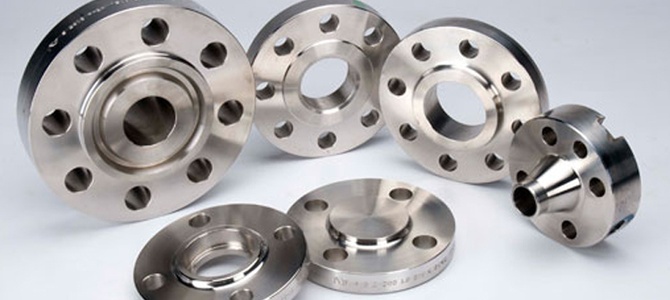
Specification of ASTM A182 Flange
| Sealing Face | RF, FF, FTJ |
| Size Range | 1/2″ – 24″ / DN15 – DN600 |
| Pressure Rating | Class 150, 300, 600, 900, 1500, 2500lb |
| Standard | ANSI / ASME B16.5, EN1092-1 |
| Flange Types | Welding Neck Flange, Slip On Flange, Socket Weld Flange, Lap Joint Flange, Threaded Flange, Blind Flange, |
| Stainless Steel | ASTM A182 F304/304L/304H, 316/316L, 310S, 317,347,904L |
Chemical Composition for ASTM A182 F304 SS Flange
| CHEMICAL | LIMITS | C | Mn | P | S | Si | Ni | Cr | Mo | N |
| ASTM A182 F304 | MIN | 8.0 | 18.0 | |||||||
| MAX | 0.08 | 2.00 | 0.045 | 0.030 | 1.00 | 11.0 | 20.0 | 0.10 | ||
| ASTM A182 F304H | MIN | 0.04 | 8.00 | 18.00 | ||||||
| MAX | 0.10 | 2.00 | 0.045 | 0.030 | 1.00 | 11.00 | 20.00 | |||
| ASTM A182 F304L | MIN | 8.00 | 18.00 | |||||||
| MAX | 0.03 | 2.00 | 0.045 | 0.030 | 1.00 | 13.00 | 20.00 | 0.10 |
Stainless Steel 304 Flange Mechanical Properties
| MATERIAL | ASTM A182 F304 | ASTM A182 F304H | ASTM A182 F304L |
| T.S (MPA) | 515 min | 515 min | 485 min |
| Y.S (MPA) | 205 min | 205 min | 170 min |
| EL % | 30 min | 30 min | 30 min |
| R/A % | 50 min | 50 min | 50 min |
Stainless Steel 304 Flange Physical Properties
| Grade | Density(kg/m3) | Elastic Modulus (GPa) | Mean Coefficient of Thermal Expansion (μm/m/°C) | Thermal Conductivity (W/m.K) | Specific Heat 0-100°C(J/kg.K) | Electrical Resistivity (nΩ.m) | |||
| 0-100°C | 0-315°C | 0-538°C | at 100°C | at 500°C | |||||
| 304/L/H | 8000 | 193 | 17.2 | 17.8 | 18.4 | 16.2 | 21.5 | 500 | 720 |
Stainless Steel 304 Flanges Equivalent
| STANDARD | WERKSTOFF NR. | UNS | JIS | BS | GOST | AFNOR | EN |
| SS 304 | 1.4301 | S30400 | SUS 304 | 304S31 | 08Х18Н10 | Z7CN18‐09 | X5CrNi18-10 |
Stainless Steel 304 Types of Flanges
Weld Neck flange
The weld neck flange has a structure with a neck and a round tube transition, which can be butt weld to the pipe to form a firm pipe connection point.
Socket weld flange
Socket Weld Flange designed in accordance with ASME B16.5 standards, is a high-integrity flange used for creating a secure pipe connection in high-pressure systems.
Threaded flange
The threaded flange uses a screw thread to connect the flange onto pipe. A male thread is cut onto a pipe end while a female thread is cut into the bore of the flange. The male threaded pipe is then screwed into the female threaded flange.
Lap joint flange
The main structural feature of the lap joint flange is the loose connection. It consists of a flange body, a flange nipple and connecting bolts. The flange body and the flange nipple are loose fitting, and this structure allows the pipeline to expand and contract freely within a certain range.
Blind flange
Blind flanges help to terminate the ends of piping systems. The main purpose of using blind flanges is to close off the unused portion of pipe or nozzle.
Slip on flange
Slip on flange is mainly used for low-pressure fluids that have minimal risk of leakage. Stainless Steel Slip On Flange is commonly used in water lines, low-pressure compressed airlines, etc.
Class 150 Stainless Steel Flange Dimension
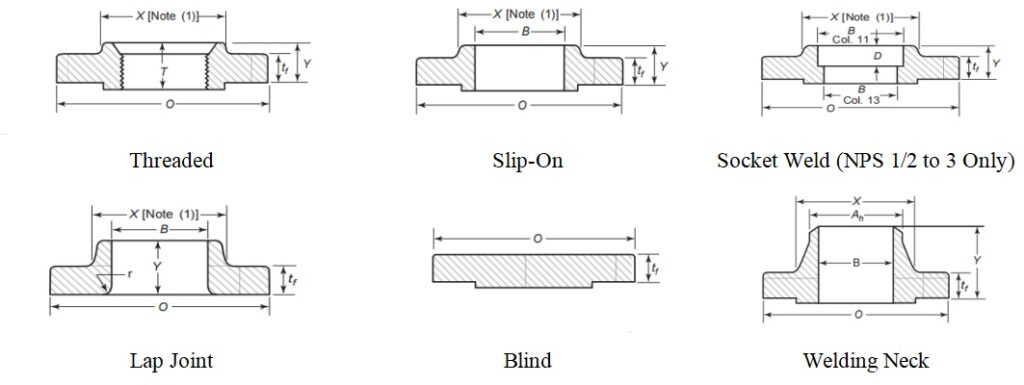
| Nominal Pipe Size, NPS |
Outside Diameter of Flange, O |
Minimum Thickness of Flange, tf [Notes(2)-(4)] |
Minimum Thickness Lap Joint, tf |
Diameter of Hub, X |
Hub Diameter Beginning of Chamfer Welding Neck, Ah [Note (5)] |
Length Through Hub | Minimum Thread Length Threaded, T [Note (6)] |
Bore | ||||
| Threaded/ Slip-on/ Socket Welding, Y |
Lapped, Y |
Welding Neck, Y |
Minimum Slip-on/ Socket Welding, B |
Minimum Lapped, B |
Welding Neck/ Socket Welding, B [Note (7)] |
|||||||
| 1/2 | 90 | 9.6 | 11.2 | 30 | 21.3 | 14 | 16 | 46 | 16 | 22.2 | 22.9 | 15.8 |
| 3/4 | 100 | 11.2 | 12.7 | 38 | 26.7 | 14 | 16 | 51 | 16 | 27.7 | 28.2 | 20.9 |
| 1 | 110 | 12.7 | 14.3 | 49 | 33.4 | 16 | 17 | 54 | 17 | 34.5 | 34.9 | 26.6 |
| 1 1/4 | 115 | 14.3 | 15.9 | 59 | 42.2 | 19 | 21 | 56 | 21 | 43.2 | 43.7 | 35.1 |
| 1 1/2 | 125 | 15.9 | 17.5 | 65 | 48.3 | 21 | 22 | 60 | 22 | 49.5 | 50.0 | 40.9 |
| 2 | 150 | 17.5 | 19.1 | 78 | 60.3 | 24 | 25 | 62 | 25 | 61.9 | 62.5 | 52.5 |
| 2 1/2 | 180 | 20.7 | 22.3 | 90 | 73.0 | 27 | 29 | 68 | 29 | 74.6 | 75.4 | 62.7 |
| 3 | 190 | 22.3 | 23.9 | 108 | 88.9 | 29 | 30 | 68 | 30 | 90.7 | 91.4 | 77.9 |
| 3 1/2 | 215 | 22.3 | 23.9 | 122 | 101.6 | 30 | 32 | 70 | 32 | 103.4 | 104.1 | 90.1 |
| 4 | 230 | 22.3 | 23.9 | 135 | 114.3 | 32 | 33 | 75 | 33 | 116.1 | 116.8 | 102.3 |
| 5 | 255 | 22.3 | 23.9 | 164 | 141.3 | 35 | 36 | 87 | 36 | 143.8 | 144.4 | 128.2 |
| 6 | 280 | 23.9 | 25.4 | 192 | 168.3 | 38 | 40 | 87 | 40 | 170.7 | 171.4 | 154.1 |
| 8 | 345 | 27.0 | 28.6 | 246 | 219.1 | 43 | 44 | 100 | 44 | 221.5 | 222.2 | 202.7 |
| 10 | 405 | 28.6 | 30.2 | 305 | 273.0 | 48 | 49 | 100 | 49 | 276.2 | 277.4 | 254.6 |
| 12 | 485 | 30.2 | 31.8 | 365 | 323.8 | 54 | 56 | 113 | 56 | 327.0 | 328.2 | 304.8 |
| 14 | 535 | 33.4 | 35.0 | 400 | 355.6 | 56 | 79 | 125 | 57 | 359.2 | 360.2 | Note(8) |
| 16 | 595 | 35.0 | 36.6 | 457 | 406.4 | 62 | 87 | 125 | 64 | 410.5 | 411.2 | Note(8) |
| 18 | 635 | 38.1 | 39.7 | 505 | 457.0 | 67 | 97 | 138 | 68 | 461.8 | 462.3 | Note(8) |
| 20 | 700 | 41.3 | 42.9 | 559 | 508.0 | 71 | 103 | 143 | 73 | 513.1 | 514.4 | Note(8) |
| 24 | 815 | 46.1 | 47.7 | 663 | 610.0 | 81 | 111 | 151 | 83 | 616.0 | 616.0 | Note(8) |
A182 Gr.F304 Pressure-Temperature Ratings
| Working Pressures by Classes,psig | |||||||
| Class | |||||||
| Temp.,F | 150 | 300 | 400 | 600 | 900 | 1500 | 2500 |
| -20 to 100 | 275 | 720 | 960 | 1440 | 2160 | 3600 | 6000 |
| 200 | 230 | 600 | 800 | 1200 | 1800 | 3000 | 5000 |
| 300 | 205 | 540 | 715 | 1075 | 1615 | 2690 | 4480 |
| 400 | 190 | 495 | 660 | 995 | 1490 | 2485 | 4140 |
| 500 | 170 | 465 | 620 | 930 | 1395 | 2330 | 3880 |
| 600 | 140 | 440 | 590 | 885 | 1325 | 2210 | 3.68 |
| 650 | 125 | 430 | 575 | 865 | 1295 | 2160 | 3600 |
| 700 | 110 | 420 | 565 | 845 | 1265 | 2110 | 3520 |
| 750 | 95 | 415 | 550 | 825 | 1240 | 2065 | 3440 |
| 800 | 80 | 405 | 540 | 810 | 1215 | 2030 | 3380 |
| 850 | 65 | 395 | 530 | 790 | 1190 | 1980 | 3300 |
| 900 | 50 | 390 | 520 | 780 | 1165 | 1945 | 3240 |
| 950 | 35 | 380 | 510 | 765 | 1.145 | 1910 | 3180 |
| 1000 | 20 | 355 | 470 | 710 | 1065 | 1770 | 2950 |
| 1050 | 325 | 435 | 650 | 975 | 1630 | 2715 | |
| 1100 | 255 | 345 | 515 | 770 | 1285 | 2145 | |
| 1150 | 205 | 275 | 410 | 615 | 1030 | 1715 | |
| 1200 | 165 | 220 | 330 | 495 | 825 | 1370 | |
| 1250 | 135 | 180 | 265 | 400 | 670 | 1115 | |
| 1300 | 115 | 150 | 225 | 340 | 565 | 945 | |
| 1350 | 95 | 125 | 185 | 280 | 465 | 770 | |
| 1400 | 75 | 100 | 150 | 225 | 380 | 630 | |
| 1450 | 60 | 80 | 115 | 175 | 290 | 485 | |
| 1500 | 40 | 55 | 85 | 125 | 205 | 345 | |
Advantages of Stainless Steel 304 Flanges
- Excellent Corrosion Resistance
Resistant to corrosion from water, steam, and acid-alkali solutions, suitable for a variety of mild to moderate corrosive environments.
- Good Mechanical Properties
High tensile strength and good toughness, suitable for welding and processing.
- High Temperature Oxidation Resistance
Can withstand temperatures up to 870°C, and up to 925°C for short periods.
- High cost-effectiveness
Offers superior performance at a cost significantly lower than high-nickel alloys and duplex steel flanges.
Application Areas
Chemical/petrochemical equipment
Food processing and brewing industry
Water supply and drainage systems
Pharmaceutical piping systems
Shipbuilding and marine engineering
Fire protection and HVAC systems