
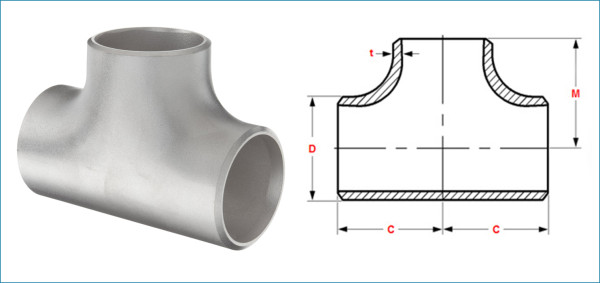
Buttweld Tee Weight Calculation Method
While buying butt weld pipe fittings, you need to calculate buttweld tee weight for checking cost of land transportation and sea shipping.. How many trucks and containers we need. You may ask how to get the weight? Now we will introduce you two methods.
Buttweld Equal Tee Weight Calculation by Formula
The first method is to use a formula to calculate buttweld equal tee weight. Honestly, it may be the basic and unique way. See formula as below.
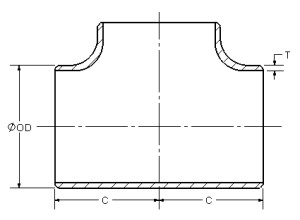
The formula is: 0.02466*(S+1.5)*[D-(S+1.5)]*(3C-D/2)/1000
S= Wall Thickness in mm
D= Outside Diameter in mm
C= Length*[Out Diameter-(Thickness+2)]*(Thickness*2)*0.02466*Length, the unit is mm.
It is quite complex and you need many specific values to do the calculation. If you don’t have a detailed dimension chart, you are hard to calculate buttweld tee weight.
To make your job easy and comfortable, we will provide the values for you.
Datasheet for Buttweld Tee Weight Calculation
| DN | NPS |
Series A |
Series B |
C | M |
| 15 | 1/2 | 21.3 | 18 | 25 | 25 |
| 20 | 3/4 | 26.9 | 25 | 29 | 29 |
| 25 | 1 | 33.7 | 32 | 38 | 38 |
| 32 |
1 1/4 |
42.4 | 38 | 48 | 48 |
| 40 |
1 1/2 |
48.3 | 45 | 57 | 57 |
| 50 | 2 | 60.3 | 57 | 64 | 64 |
| 65 |
2 1/2 |
73 | 76 | 76 | 76 |
| 80 | 3 | 88.9 | 89 | 86 | 86 |
| 90 |
3 1/2 |
101.6 | – | 95 | 95 |
| 100 | 4 | 114.3 | 108 | 105 | 105 |
| 125 | 5 | 141.3 | 133 | 124 | 124 |
| 150 | 6 | 168.3 | 159 | 143 | 143 |
| 200 | 8 | 219.1 | 219 | 178 | 178 |
| 250 | 10 | 273 | 273 | 216 | 216 |
| 300 | 12 | 323.9 | 325 | 254 | 254 |
| 350 | 14 | 355.6 | 377 | 279 | 279 |
| 400 | 16 | 406.4 | 426 | 305 | 305 |
| 450 | 18 | 457 | 480 | 343 | 343 |
| 500 | 20 | 508 | 530 | 381 | 381 |
| 550 | 22 | 559 | – | 419 | 419 |
| 600 | 24 | 610 | 630 | 432 | 432 |
Equal Tee Weight Calculation by Chart
The second method is to calculate by chart. It is as simple as using calculator, the only disadvantage is you can only get the weight of some specific sizes. But it is useful than we thought because even butt weld tees have a large dimension range, the regular sizes are all covered in the chart. According to the wall thickness and diameter, you can get the weight easy and fast.
Buttweld Equal Tee Weight Chart
| DN | NPS | STD | 40 | XS | 80 | 160 | XXS |
| 15 | 1/2 | 0.21 | 0.2 | 0.2 | 0.2 | ||
| 20 | 3/4 | 0.2 | 0.2 | 0.3 | 0.3 | ||
| 25 | 1 | 0.3 | 0.3 | 0.5 | 0.5 | ||
| 32 | 1 1/4 | 0.6 | 0.6 | 0.7 | 0.7 | ||
| 40 | 1 1/2 | 0.9 | 0.9 | 1.3 | 1.3 | 1.5 | 1.3 |
| 50 | 2 | 1.5 | 1.5 | 2.2 | 2.2 | 2.7 | 3.4 |
| 65 | 2 1/2 | 2.7 | 2.7 | 3.0 | 3.0 | 3.1 | 3.8 |
| 80 | 3 | 3.8 | 3.8 | 4.4 | 4.4 | 5.6 | 6.1 |
| 90 | 3 1/2 | 4.6 | 4.6 | 5.9 | 5.9 | ||
| 100 | 4 | 6.5 | 6.5 | 7.7 | 7.7 | 10.2 | 12.9 |
| 125 | 5 | 9.7 | 9.7 | 13.5 | 13.5 | 19.8 | 25.7 |
| 150 | 6 | 14 | 14 | 19.3 | 19.3 | 34 | 30.6 |
| 200 | 8 | 24.5 | 24.5 | 34.5 | 34.5 | 50 | 47.7 |
| 250 | 10 | 41.3 | 41.3 | 58.4 | 67.5 | 111.2 | 84.7 |
| 300 | 12 | 65 | 69 | 76.5 | 105 | 158 | 129 |
| 350 | 14 | 83 | 96 | 104 | 142 | 232 | |
| 400 | 16 | 110 | 120 | 120 | 187 | 335 | |
| 450 | 18 | 132 | 170 | 159 | 263 | 564 | |
| 500 | 20 | 168 | 240 | 192 | 356 | 756 | |
| 550 | 22 | 185 | 209 | 416 | 1002 | ||
| 600 | 24 | 222 | 345 | 251 | 548 | 1215 |
Equal Tee VS Reducing Tee
An Equal Tee and a Reducing Tee are both essential pipe fittings used to combine or split fluid flow in piping systems. The main difference lies in their outlet sizes — an Equal Tee has three outlets of the same diameter, ensuring uniform flow distribution, while a Reducing Tee has one branch outlet smaller than the main pipe, allowing for flow reduction or connection to different pipe sizes. Both types are available in various materials and standards, such as ASME B16.9, and are widely used in industries like oil & gas, chemical, and power generation.
Lateral Tee
A Lateral Tee is a type of pipe fitting used to branch a pipeline at an angle, typically 45 degrees rather than the standard 90 degrees of a regular tee. This design allows smoother flow direction and minimizes pressure loss, making it ideal for systems requiring efficient fluid or gas distribution. Lateral tees are commonly used in oil, gas, chemical, and power industries, and are available in materials such as carbon steel, stainless steel, and alloy steel, conforming to standards like ASME B16.9.